
Search
Did you mean: Baal?
Remove Ads
Advertisement
Search Results

Definition
Medieval Monastery
A medieval monastery was an enclosed and sometimes remote community of monks led by an abbot who shunned worldly goods to live a simple life of prayer and devotion. Christian monasteries first developed in the 4th century in Egypt and Syria...

Article
Byzantine-Armenian Relations
The relationship between the Byzantine Empire and ancient Armenia was a constant and varied one with an equal mix of wars, occupations, treaties of friendship, mutual military aid, and cultural exchange. Regarded as a vital defence to the...

Definition
Constantinople
Built in the seventh century BCE, the ancient city of Byzantium proved to be a valuable city for both the Greeks and Romans. Because it lay on the European side of the Strait of Bosporus, the Emperor Constantine understood its strategic importance...

Definition
Byzantine Emperor
The Byzantine Emperor ruled as an absolute monarch in an institution which lasted from the 4th to 15th century CE. Aided by ministers, high-ranking nobility, and key church figures, the emperor (and sometimes empress) was commander-in-chief...

Definition
Isaac I Komnenos
Isaac I Komnenos was the Byzantine emperor from 1057 to 1059 CE. Although his reign was brief, he was known for being a capable and militarily astute general and emperor. As the first emperor to lead troops himself in battle in over 30 years...

Definition
Mount Athos - The Byzantine Holy Mountain
Mount Athos, located on the Chalkidike peninsula near Thessalonica, Greece, is a holy site which first saw hermit monks living there in the 9th century CE. Regarded as one of the most important monastic sites in the Byzantine Empire, there...
Definition
Trdat the Architect
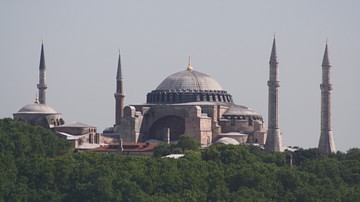
“Trdat the Architect” or Tiridates (c. 940s-c. 1020s?) was a Armenian architect who is noted for his role in the reconstruction of the Hagia Sophia's dome in Constantinople following an earthquake in the 10th century CE, as well as the Cathedral...

Definition
Byzantine Government
The government of the Byzantine Empire was headed and dominated by the emperor, but there were many other important officials who assisted in operating the finances, judiciary, military, and bureaucracy of a huge territory. Without elections...

Definition
Byzantine Coinage
The coinage of the Byzantine Empire continued that of its more ancient predecessors and functioned as a convenient method of payment for goods and services, especially to soldiers and officials, and as a means for people to pay their taxes...
Definition
Constantine VII
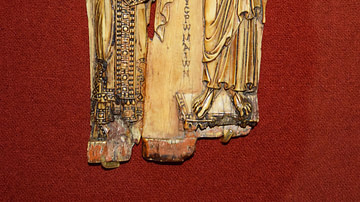
Constantine VII was Byzantine emperor from 945 until 959 CE. Sometimes known as Constantine Porphyrogennetos because of his birth in the purple chamber of the royal palace, he was served by various regents from 912 CE until reigning in his...
