
Search
Did you mean: Baal?
Remove Ads
Advertisement
Search Results

Image
Psalter of Basil II
An early 11th century CE depiction of Byzantine emperor Basil II (r. 976-1025 CE) being crowned and armed by archangels. He is being blessed by God from above and worshipped by military saints on both sides. Below, courtiers and defeated...
Image
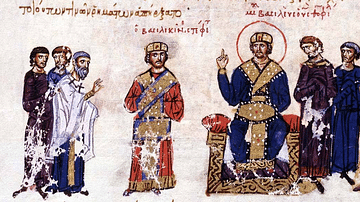
Michael III Crowns Basil Co-emperor
A 13th century CE illustration showing Byzantine emperor Michael III (r. 842-867 CE) crowning his great friend and political ally Basil the Macedonian co-emperor. The latter would take the crown himself in 867 CE as Basil I. (Madrid Sklitzes...
Image
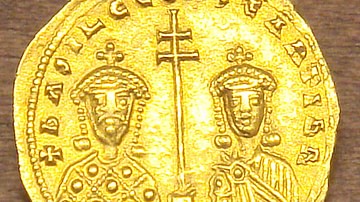
Coin of Basil II
A gold coin of Basil II, emperor of the Byzantine empire (r. 976-1025 CE). Showing Basil and his brother and successor Emperor Constantine VIII. (Musee Saint-Denis, Paris)

Definition
Nikephoros II Phokas
Nikephoros II Phokas was Byzantine emperor from 963 to 969 CE. Known as “White Death of the Saracens,” Nikephoros was a fearsome commander who conquered Crete, Cilicia, and much of Syria. While he is known as a great military commander, he...

Definition
Michael III
Michael III, also known as “Michael the Drunkard” by his detractors, was emperor of the Byzantine Empire from 842 to 867 CE. Never quite escaping the shadow of his mother Theodora, who ruled as regent in his name until c. 855 CE, or his uncle...

Definition
The Constantinian Excerpts - The 10th Century Byzantine Encyclopedia
The Constantinian Excerpts, or Excerpta Constantiniana is the conventional name given to the mid-10th Century Byzantine palace encyclopedia commissioned by the scholar emperor Constantine VII ‘Porphyrogenitus’ (reign 945-959). It was a work...

Definition
John I Tzimiskes
John I Tzimiskes was Byzantine emperor from 969 to 976 CE. Although he took the throne by murdering his predecessor Nikephoros II Phokas, John was a popular emperor. A skilled general and a competent politician, he is known for expanding...

Definition
Leo VI
Leo VI was emperor of the Byzantine empire from 886-912 CE. He was the second emperor of the Macedonian dynasty and is sometimes known as “Leo the Wise” in reference to his prolific literary output which ranged from orations to law codes...

Article
Byzantine Monasticism
Monasticism, that is individuals devoting themselves to an ascetic life in a monastery for devotional purposes, was an ever-present feature of the Byzantine empire. Monasteries became powerful landowners and a voice to be listened to in imperial...

Definition
Byzantine Empire
The Byzantine Empire existed from 330 to 1453. It is often called the Eastern Roman Empire or simply Byzantium. The Byzantine capital was founded at Constantinople by Constantine I (r. 306-337). The Byzantine Empire varied in size over the...
