
Search
Did you mean: Baal?
Remove Ads
Advertisement
Search Results

Definition
Michael Psellos
Michael Psellos (1018 - c. 1082 CE) was a Byzantine historian, writer, and intellectual. Michael acted as courtier and advisor to several Byzantine emperors, and he was the tutor of Michael VII. Writing between 1042 and 1078 CE, his texts...

Definition
Michael IV the Paphlagonian
Michael IV the Paphlagonian was Byzantine emperor from 1034 to 1041 CE. He had an affair with Empress Zoe, then married her and was crowned emperor after the death of her first husband, Romanos III. He ran a competent regime that kept the...

Article
The Great Palace of Constantinople
The Great Palace of Constantinople was the magnificent residence of Byzantine emperors and their court officials which included a golden throne room with wondrous mechanical devices, reception halls, chapels, treasury, and gardens. In use...

Definition
Kievan Rus
Kievan Rus (862-1242) was a medieval political federation located in modern-day Belarus, Ukraine, and part of Russia (the latter named for the Rus, a Scandinavian people). The name Kievan Rus is a modern-day (19th century) designation but...

Definition
Romanos IV Diogenes
Romanos IV Diogenes ruled the Byzantine Empire from 1068 to 1071 CE. He was a military emperor, and his policies and campaigns served to shore up Byzantine defenses against the Seljuk Turks. However, in the aftermath of the Byzantine defeat...

Article
Trade in the Byzantine Empire
Trade and commerce were essential components of the success and expansion of the Byzantine Empire. Trade was carried out by ship over vast distances, although for safety, most sailing vessels were restricted to the better weather conditions...

Article
Pilgrimage in the Byzantine Empire
Pilgrimage in the Byzantine Empire involved the Christian faithful travelling often huge distances to visit such holy sites as Jerusalem or to see in person relics of holy figures and miraculous icons on show from Thessaloniki to Antioch...

Article
The Differences Between Byzantine & Armenian Christianity
Although both the Byzantines and the Armenians were Christian, the types of Christianity they professed had important differences that led to a lack of recognition and tensions between the two groups and a considerable part of their relationship...
Definition
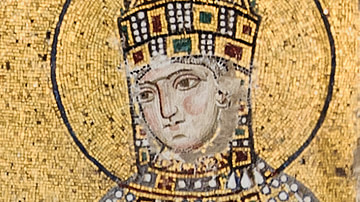
Empress Zoe - The Great Byzantine Ruler
Zoe Porphyrogenita was empress of the Byzantine Empire from 1028 CE until her death in 1050 CE. In an eventful career, she reigned alongside three husbands, had a hand in the succession of her adopted son, and, in 1042 CE, she was co-ruler...

Definition
Eustathios Rhomaios - Judge and Jurist of the Byzantine Empire
Eustathios Rhomaios was a prominent Byzantine judge and jurist during the late-10th and early- to mid-11th century. He studied Roman Law and began his career under Basil II (reign 976 to 1025) and became the chief judge during the mid-1020s...
