
Search
Remove Ads
Advertisement
Search Results

Article
The Armies of the Crusades
The armies of the Crusades (11th-15th centuries CE), which saw Christians and Muslims struggle for control of territories in the Middle East and elsewhere, could involve over 100,000 men on either side who came from all over Europe to form...

Article
Mongol Multiculturalism
The Mongol Empire accepted and promoted many other cultures. Historians often talk about cultural exchange across Asia in the Mongol Empire as something that was just facilitated by peace and stability across such a huge area – the 'Pax Mongolica'...

Article
The Portuguese Conquest of India
Throughout the 15th century, the Portuguese Crown yearned for a piece of the Far Eastern spice trade. For centuries this trade had been dominated by the Venetians who obtained pepper, cloves, nutmeg, ginger and cinnamon from their Middle...

Article
European Discovery & Conquest of the Spice Islands
Clove, nutmeg, and mace are native to only a handful of tiny islands in the middle of the vast Indonesian archipelago – cloves on five Maluku Islands (the Moluccas) about 1250 km (778 mi) west of New Guinea, and nutmeg on the ten Banda Islands...

Article
Saladin & the Unification of the Muslim Front: 1169-1187 CE
Saladin (c. 1137 – 1193 CE), the Muslim ruler who crushed the mighty Crusader army at the Horns of Hattin (1187 CE) and re-took Jerusalem after 88 years of Crusader control, was born in a world where the disunity of the Muslims had allowed...

Article
The Portuguese in East Africa
The Portuguese first took an interest in East Africa from the beginning of the 16th century as their empire spread eastwards across the Indian Ocean. Trade in the region was already well-established and carried out by Africans, Indians, and...
Article
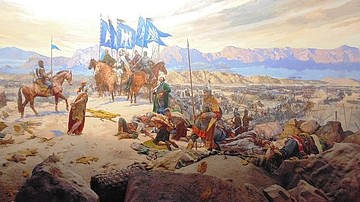
Battle of Manzikert
The Battle of Manzikert (Mantzikert) in ancient Armenia in August 1071 CE was one of the greatest defeats suffered by the Byzantine Empire. The victorious Seljuk army captured the Byzantine emperor Romanos IV Diogenes, and, with the empire...

Article
Solomonic Descent in Ethiopian History
The Solomonic Dynasty ruled Ethiopia from the 1270s to the 1970s, and the 14th-century work, the Kebra Nagast (The Glory of the Kings) famously tells of how the dynasty of Ethiopian kings descended from King Solomon himself. The descent from...

Interview
Oman: The Land of Frankincense - Tony Walsh
While Oman is perhaps the most mysterious corner of the Arabian peninsula to Westerners, the country retains a strong sense of identity, a pride in its ancient past, and unique surprises in the domain of cultural heritage. In this exclusive...

Image
Map of the Latin Empire: A Crusader State in Constantinople - Imperium Romaniae and the Fragmentation of Byzantium
The Imperium Romaniae, commonly known as the Latin Empire (1204–1261), emerged from the upheaval of the Fourth Crusade (1202–1204), when Western European forces captured and sacked Constantinople in 1204. This event brought an abrupt end...
