
Search
Remove Ads
Advertisement
Search Results

Image
Part of Tablet V, the Epic of Gilgamesh
A newly discovered partially broken tablet V of the Epic of Gilgamesh: "the episode of the journey of Gilgamesh and Enkidu." According to Professor Farouk Al-Rawi (of the School of Oriental and African Studies...

Image
Ruins of the North Palace of Nebuchadnezzar II
These are the ruins of the so-called "North Palace" of Nebuchadnezzar II at the ancient city of Babylon. Neo-Babylonian period, reign of Nebuchadnezzar II, 6th century BCE.
Image
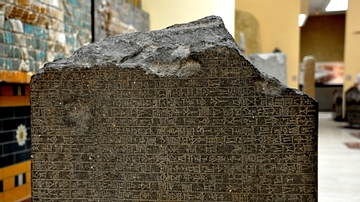
Stele of King Nabonidus, a close-up view
It narrates the various religious activities of king Nabonidus and contains the harassment of enemies to the city of Babylon and nearby cities and the renovation of these cities by him as well as homage paid...

Image
The Story of Gilgamesh & Aga
This literary text narrates the war between Gilgamesh (king of Uruk) and Aga (the last king of the first dynasty Kish). The Epic of Gilgamesh mentioned that Aga had besieged Uruk. Purchase. From Southern Mesopotamia...

Image
Map of the The Mitanni (Hanigalbat) empire, c. 1600-1300 BCE - Between Egypt and the Hittites, A Kingdom of Diplomacy and War
The Mitanni Empire was a major Late Bronze Age power that rose in northern Mesopotamia and Upper Syria between c. 1600 and 1300 BCE, shaping...

Image
Mesopotamian Ceramic Objects Used in Magical Liturgy
Three rounded ceramic objects with saw-teeth-like margins. They have small holes on both the ventral and the dorsal aspects. Upon moving them, a sound comes out as if there is a small object inside...
Image
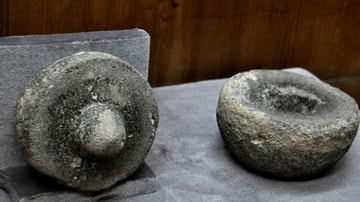
Rotating Device of a Potter's Wheel
This rotating device of a potter's wheel was made of stone and dates back to the Old Babylonian period, 2000-1500 BCE, Mesopotamia, Iraq. (The Sulaimaniya Museum, Iraq).

Image
Ishtar Clay Mould
This is a fired clay mould for the goddess Ishtar. The goddess is depicted nude. She holds her breasts with her hands and wears a horned crown. She has a pair of wings (or a cloak) and her feet are talon-like. On the left is...

Book Review
Mathematics in Ancient Egypt: A Contextual History
Mathematics in Ancient Egypt traces the development of Egyptian mathematics, from the end of the 4th millennium BC to the end of the Pharaonic Period in Greco-Roman times. Imhausen uses mathematical...
Image
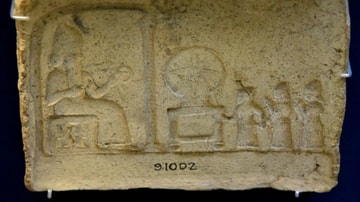
Clay Cover of the Tablet of Shamash (II)
This is a fired clay cover of the sun god (Shamash) tablet. Its purpose was to protect the obverse side (face) of the tablet. It has retained the impression of the carved panel of the tablet. The Babylonian...
