
Search
Remove Ads
Advertisement
Search Results

Article
Mesopotamian Education - Creating the First Written Works in History
Mesopotamian education was invented by the Sumerians following the creation of writing circa 3600/3500 BCE. The earliest schools were attached to temples, but later schools were established...

Article
Diasporic Communities in the Mediterranean & Beyond
A diaspora is a large group of people with a similar heritage or homeland who have since moved from their original homelands to another country. In terms of ethnicity, they share a common language...

Article
Festivals in Ancient Mesopotamia - Courting the Goodwill of the Gods
Festivals in ancient Mesopotamia honored the patron deity of a city-state or the primary god of the city that controlled a region or empire. The earliest, the Akitu festival, was first...

Article
The Atrahasis Epic: The Great Flood & the Meaning of Suffering
The Atrahasis is the Akkadian/Babylonian epic of the Great Flood sent by the gods to destroy human life. Only the good man, Atrahasis (his name translates as `exceedingly wise') was warned...

Article
Ethnicity & Identity Within the Four-Room House
The process of determining ethnicity is a problematic venture, even more so when interpreted through the archaeological record. Despite this issue, evidence, such as the four-room house, has been preserved...
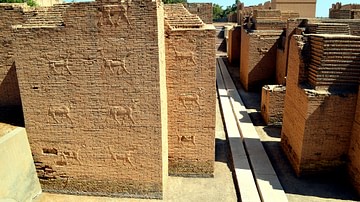
Image
Part of the Processional Way at Babylon
This is part of the processional way (or street) at the ancient city of Babylon, in modern-day Iraq. The reliefs of aurochs (bulls) and mušḫuššus (dragons) are originals, as are the flanking walls. Neo-Babylonian...

Image
God and Goddess from Mesopotamia
The upper halves of terracotta plaques, depicting a male figure (on the left, who has a long beard) and a female figure (on the right, with bare breast) wearing a horned headdress (symbol of divinity) and appearing...

Image
Ningishzida
Old-Babylonian fired clay plaque depicting Ningishzida, the Mesopotamian deity of vegetation and the underworld, flanked by 2 small human figures. Found during the 2nd excavation season of the Oriental Institute of the University...
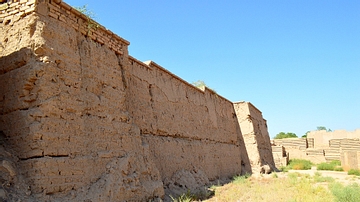
Image
The Inner walls of Babylon
This wall is part of a large and long wall at the ancient city of Babylon, in modern-day Iraq. The walls lie before the so-called Southern Palace of Nebuchadnezzar II. Neo-Babylonian period, reign of Nebuchadnezzar II...

Image
Part of Tablet V, the Epic of Gilgamesh
A newly discovered partially broken tablet V of the Epic of Gilgamesh: "the episode of the journey of Gilgamesh and Enkidu." According to Professor Farouk Al-Rawi (of the School of Oriental and African Studies...
