
Search
Remove Ads
Advertisement
Search Results

Article
The Atrahasis Epic: The Great Flood & the Meaning of Suffering
The Atrahasis is the Akkadian/Babylonian epic of the Great Flood sent by the gods to destroy human life. Only the good man, Atrahasis (his name translates as `exceedingly wise') was warned...

Article
Ethnicity & Identity Within the Four-Room House
The process of determining ethnicity is a problematic venture, even more so when interpreted through the archaeological record. Despite this issue, evidence, such as the four-room house, has been preserved...

Article
David & Goliath
As a youngster, David (the later king of Israel), slew Goliath, a giant, who was the champion of Israel’s enemy, the Philistines. "David and Goliath" became a metaphor for an underdog who nevertheless is victorious over a more...

Article
Fashion & Dress in Ancient Mesopotamia - From Basic to Accessorized in the Ancient World
Fashion and dress in Mesopotamia – clothing, footwear, and accessories – were not only functional but defined one's social status and developed from a simple loincloth in...

Article
Dadan, Tayma, Khaybar, Qurh & Old Town AlUla - More Stunning Sites at AlUla, Saudi Arabia
Khaybar, Tayma, Dadan, Qurh, and AlUla Old Town are sites situated in the AlUla region of Saudi Arabia, an area on the ancient incense trade routes. Khaybar and Tayma are...

Article
Third Gender Figures in the Ancient Near East
In the ancient Near East, there was a social standard by which men were ideally expected to behave. In the 21st century CE, expectations still exist, albeit in different forms. Normative masculinity through...
Article
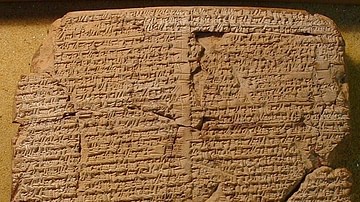
Ancient Mesopotamian Ghost Spell - Keeping the Dead Where They Belong
Medicine in ancient Mesopotamia was based on the belief that illness was caused by supernatural agencies and, although medicines were given and injuries treated, magical spells and incantations...

Article
The Athenian Calendar
The term "Athenian Calendar" (also called the "Attic Calendar") has become somewhat of a misnomer, since Ancient Athenians never really used just one method to reckon the passage of time. Athenians, especially from the 3rd...

Article
Hymn to Nungal - A Praise Song for the Sumerian Goddess of Prisons
The Hymn to Nungal (circa 1894-1595 BCE) is a Sumerian poem praising Nungal, the goddess of prisons and rehabilitation (also associated with the underworld), as well as the prison house...

Article
Sammu-Ramat and Semiramis: The Inspiration and the Myth
Sammu-Ramat (r. 811-806 BCE) was the queen regent of the Assyrian Empire who held the throne for her young son Adad Nirari III (r. 811-783 BCE) until he reached maturity. She is also known as Shammuramat...
