
Search
Remove Ads
Advertisement
Search Results

Article
Enheduanna - Poet, Priestess, Empire Builder - Redefining the Gods for the People
Enheduanna (circa 2300 BCE) is the world's first author and was the daughter (either literally or figuratively) of the great empire-builder Sargon of Akkad (reign 2334-2279 BCE...

Article
Royal Women in the Mughal Empire
It was not only the Mughal emperors that left an indelible mark in the history of the Indian subcontinent but also the queens and princesses. The latter's contributions to art, architecture, literature, cuisine, refinement...
Video
Babylonian Bricks (82nd & Fifth)
http://82nd-and-fifth.metmuseum.org/bricks Explore this object: http://82nd-and-fifth.metmuseum.org/two-panels-with-striding-lions-babylonian-31.13.1-.2 "It always had this possibility to come alive in a very...

Article
Society in the Byzantine Empire
The society in the Byzantine Empire (4th-15th century CE) was dominated by the imperial family and the male aristocracy but there were opportunities for social advancement thanks to wars, population movements, imperial...

Article
Women in the Byzantine Empire
Women in the Byzantine Empire (4th to 15th century CE) were, amongst the upper classes, largely expected to supervise the family home and raise children while those who had to work for a living did so in most of the...

Definition
Library of Ashurbanipal
The Library of Ashurbanipal (7th century BCE) is the oldest known systematically organized library in the world, established in Nineveh by the Neo-Assyrian king Ashurbanipal (r. 668-627 BCE) to preserve the history and culture...
Definition
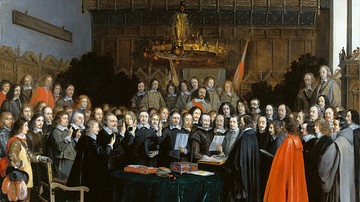
Peace of Westphalia
The Peace of Westphalia, the name given to the multiple treaties, marked the conclusion of the Thirty Years' War. Signed on 24 October 1648, it aimed to secure political autonomy for the multitude of small states that made...

Article
Women in Ancient Mesopotamia - Celebrating the Feminine Principle in the Near East
The lives of women in ancient Mesopotamia cannot be characterized as easily as with other civilizations, owing to the different cultures over time. Generally speaking, though...

Interview
Interview: Empire of the Black Sea by Duane Roller
Multiple Fulbright Award-winning Duane Roller joins us to talk about his new book, Empire of the Black Sea. The first thorough analysis in English of the dynasty as a whole, Empire of the Black Sea...

Article
Women in the Mongol Empire
Women in the Mongol Empire (1206-1368 CE) shared the daily chores and hardships of steppe life with men and were largely responsible for tending animals, setting up camps, childrearing, producing food and cooking it. Having...
