
Search
Remove Ads
Advertisement
Search Results

Article
The Nerge: Hunting in the Mongol Empire
The peoples of the Mongol Empire (1206-1368 CE) were nomadic, and they relied on hunting wild game as a valuable source of protein. The Asian steppe is a desolate, windy, and often bitterly cold environment, but for those Mongols with sufficient...

Article
Paper in Ancient China
The widespread use of paper and printing were features of ancient China which distinguished it from other ancient cultures. Traditionally, paper was invented in the early 2nd century CE, but there is evidence it was much earlier. As a cheaper...

Definition
Silk Road
The Silk Road was a network of ancient trade routes, formally established during the Han Dynasty of China in 130 BCE, which linked the regions of the ancient world in commerce between 130 BCE-1453 CE. The Silk Road was not a single route...

Definition
Mongol Empire
The Mongol Empire (1206-1368) was founded by Genghis Khan (r. 1206-1227), first Great Khan or 'universal ruler' of the Mongol peoples. Genghis forged the empire by uniting nomadic tribes of the Asian steppe and creating a devastatingly effective...

Image
San Marco Altarpiece
San Marco Altarpiece, painting by Fra Angelico, photograph by Louis-Garden, Florence, 13 February, 2012. Between the years of 1438-1442 CE, Fra Angelico created The San Marco Altarpiece. As the name suggests, it was originally intended for...

Article
Mongol Multiculturalism
The Mongol Empire accepted and promoted many other cultures. Historians often talk about cultural exchange across Asia in the Mongol Empire as something that was just facilitated by peace and stability across such a huge area – the 'Pax Mongolica'...

Definition
Chagatai Khanate
The Chagatai Khanate (also Chaghatai, Jagatai, Chaghatay or Ca'adai, c. 1227-1363 CE) was that part of the Mongol Empire (1206-1368 CE) which covered what is today mostly Uzbekistan, southern Kazakhstan, and western Tajikistan. The khanate...

Collection
Travel & Exploration Before Columbus
Ancient peoples were as curious as ourselves about the wider world and even if the transport at their disposal meant travel could be long, arduous and dangerous, they still managed to get about and visit different cities, sacred sites and...

Image
Atrium of Villa San Marco in Stabiae
View of the four-colonnaded atrium of the Villa San Marco in Stabiae, Italy (1st century BCE). The tetrastyle atrium was entered through a small colonnaded and frescoed portico furnished with masonry seats for waiting visitors. Looking across...
Image
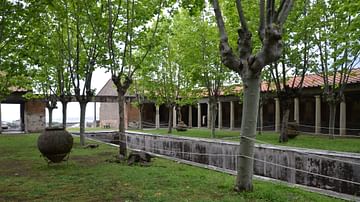
Peristyle of Villa San Marco in Stabiae
The large peristyle of Villa San Marco in Stabiae (Italy) contained a 30m (98 ft) long garden and pool. Originally a line of plane trees ran down the sides of the pool and the trees have been replanted accordingly. 1st century CE.
