
Search
Remove Ads
Advertisement
Search Results

Definition
Ali ibn Abi Talib
Ali ibn Abi Talib, or simply Ali, (l. 601-661 CE) was among the first Muslims, a cousin and son-in-law of the Islamic Prophet Muhammad (l. 570-632 CE), and later reigned as the fourth Caliph of Islam from 656 CE to 661 CE, when he was murdered...

Definition
Rashidun Caliphate
The first four caliphs of the Islamic empire – Abu Bakr, Umar, Uthman, and Ali are referred to as Rashidun (rightly guided) Caliphs (632-661 CE) by mainstream Sunni Muslims. Their tenure started with the death of Prophet Muhammad in 632 CE...

Article
Women in Ancient China
Women in ancient China did not enjoy the status, either social or political, afforded to men. Women were subordinate to first their fathers, then their husbands, and finally, in the case of being left a widow, their sons in a system known...

Definition
First Fitna
The First Fitna (656-661 CE) was the first civil war of the Islamic Empire fought between the fourth Rashidun Caliph, Ali ibn Abi Talib (656-661 CE), and the governor of Syria, Muawiya (later Muawiya I; r. 661-680 CE). Deep fissures divided...

Image
Extent of the Teutonic Order c. 1300 CE
A map indicating the commanderies and territories (shaded blue) under the control of the Teutonic Order c. 1300 CE.

Image
Red-Figure Depiction of Croesus
A depiction of Croesus (r. 560-546 BCE), the King of Lydia on a Greek red-figure pottery vase. Lydia was a region in western Asia Minor (modern-day Turkey) and was so wealthy that the expression "as rich as Croesus" originates in reference...
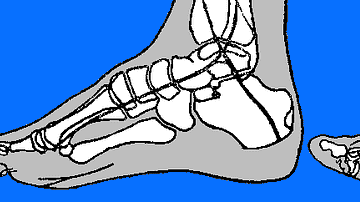
Image
The Effects of Foot-binding on the Foot Bones
A diagram showing the effect on the bones of the foot from the ancient Chinese practice of foot-binding.

Image
Egyptian Dancer
Ostracon depicting an Egyptian dancer, found at Deir el-Medina. New Kingdom of Egypt, 19th or 20th Dynasties, (c. 1200 BCE).
Egyptian Museum, Turin.

Image
Ardashir I Unseats Artabanus, Firuzabad Relief
Ardashir I unseats Artabanus, Firuzabad Relief, Iran, 224-241 CE

Image
Anatomical Theatre, Padua
A photograph of a reconstruction of the original anatomical theatre at the University of Padua, Italy. In use in the Early-modern period and used for dissections before an audience.
