


The Battle of Chickamauga (19-20 September 1863) was a decisive battle in the western theater of the American Civil War (1861-1865). Fought along the Chickamauga Creek in northwestern Georgia, the battle saw the Confederate Army of Tennessee, under General Braxton Bragg, win a significant yet costly victory over the Union Army of the Cumberland, under Major General William S. Rosecrans. Chickamauga was the greatest Confederate victory in the West, and was also the second bloodiest battle of the entire war, resulting in over 35,000 total casualties.

Background
It was the third summer of the rebellion – July 1863 – and it appeared that the Southern Confederacy was tottering at the edge of the abyss. In Pennsylvania, General Robert E. Lee and his intrepid Army of Northern Virginia had met with defeat at the climactic Battle of Gettysburg (1-3 July); though Lee had escaped complete annihilation, leading his tattered army back to the safety of Virginian soil, he would never again have the strength to attempt an invasion of the North. Along the Mississippi River, meanwhile, the months-long Siege of Vicksburg had also resulted in a devastating Confederate defeat. By capturing the river stronghold, the Union had managed to effectively cut the Confederate territory in two. These twin Union victories seemed to signal that the tide of war was finally turning; indeed, US President Abraham Lincoln and his cabinet had reason to believe that one more substantial victory could be enough to crush the rebellion for good.
For this victory, they turned their eyes to Tennessee, a hotly contested state where the Union Army of the Cumberland, under the frantic Major General William S. Rosecrans, was facing down the Confederate Army of Tennessee, under the prickly General Braxton Bragg. The two armies had clashed half a year earlier, at the Battle of Stones River (31 December to 2 January), but had since remained largely inactive; Bragg had withdrawn his army 30 miles south, to the city of Tullahoma, while Rosecrans had remained in Murfreesboro. All through the spring, Rosecrans had received numerous entreaties from the Lincoln administration to act – if he could seize the railroad hub of Chattanooga, Tennessee, Rosecrans could open the Confederate heartland to Union invasion. Rosecrans found every reason to stall, citing lack of supplies and unwillingness to march along the muddy spring roads, much to the president's exasperation.
Finally, on 24 June 1863, Rosecrans leapt into action. Each of his four infantry corps marched south, swiftly moving through the Cumberland foothills, feinting and maneuvering around the Confederate lines. Bragg – taken completely off guard by Rosecrans's sudden burst of activity – opted to withdraw to Chattanooga rather than fight a battle on the enemy's terms. On 3 July – the same day that Lee's soldiers were mounting their last, ill-fated charge at Gettysburg, 700 miles away – Rosecrans's rapid Tullahoma Campaign came to an end. At the cost of only 570 casualties, he had driven the Confederates out of Middle Tennessee. It was certainly a triumph, albeit one that the victorious Union general was none too eager to exploit. When, on 7 July, Secretary of War Edwin M. Stanton urged him to continue on to Chattanooga, Rosecrans felt vexed by the lack of appreciation for his near-bloodless victory, replying, "I beg in behalf of this army that the War Department may not overlook so great an event because it is not written in letters of blood…" (quoted in McPherson, 669).
It was not until 16 August – after weeks of additional prodding from Washington – that Rosecrans finally kicked his army back into gear. Once in motion, however, his men moved swiftly. By the end of the month, the Army of the Cumberland had crossed the Tennessee River and was positioning itself to threaten Chattanooga from the south. With the enemy approaching, Bragg was once again faced with the choice of fighting or retreating. Although he had been promised reinforcements – Lt. General James Longstreet was already on his way with two battle-hardened divisions, fresh off the Gettysburg battlefield – Bragg was worried that they would not come in time, and did not believe he could hold off Rosecrans on his own.

So, on 8 September, he opted to evacuate Chattanooga and pull his army back into Georgia. Union forces occupied the railroad hub the next day. Thus, without even fighting a decisive battle, Rosecrans had not only captured Chattanooga but had driven Bragg entirely out of Tennessee. For the Confederates, the loss of Tennessee was almost too much to bear; indeed, Confederate President Jefferson Davis himself despaired that "we are now in the darkest hour of our political existence" (quoted in McPherson, 671).
Preparing for Battle
There was, however, method to Bragg's madness. Confederate papers raged and howled at his decision to abandon Chattanooga, little knowing that he planned to lure Rosecrans into a trap. By now, he knew that Rosecrans's four corps often travelled separately and in isolation from one another – while this increased maneuverability, this distance limited their ability to come to one another's aid in case of attack. If he could draw the Yankees through the mountains and into the valley south of Chattanooga, then Bragg could pounce on each of Rosecrans's corps individually, destroying them one by one. To encourage Rosecrans to pursue him, Bragg sent fake deserters into the Union lines to feed the enemy false information regarding Confederate dispositions and troop movements.
Rosecrans, overconfident and drunk on victory, took the bait. Against the better judgment of his subordinates – including that of Major General George H. Thomas, who explicitly warned him that he was walking into a trap – Rosecrans set off in pursuit of his enemy, hoping to finally bag the Confederate fox. Fortunately for him, Bragg had not set his trap particularly well. Three times between 10 and 13 September, Bragg ordered two or more of his divisions to attack isolated fragments of the advancing Union army. All three times, his division commanders found excuses not to carry out the attack. By 12 September, Rosecrans realized how close he had come to annihilation and decided to concentrate his forces, considering it "a matter of life or death." Having lost the element of surprise, Bragg was forced to formulate a new plan. On 15 September, he and his corps commanders agreed to stop retreating and go on the offensive, to hit Rosecrans's flank, drive him back, and retake Chattanooga.

The next few days passed in foreboding silence, as both armies concentrated their forces. On 17 September, Bragg was joined by two Virginia divisions under Major General John Bell Hood, who promised that the rest of Longstreet's reinforcements were not far behind; Bragg now had 65,000 men, giving him a slight numerical advantage over Rosecrans's 60,000 troops. Emboldened, Bragg "emerged Achilles-like from his sulk" and ordered his troops to the west bank of the Chickamauga Creek, where he hoped to wedge himself between the Union army and Chattanooga (Foote, 715). It is often said that the name Chickamauga came from a Cherokee word meaning "river of death" (Cozzens, 90). While this meaning is debated – some scholars believe it to be a loose translation, while others believe the name means something else entirely – it was certainly an apt description, for the waters of the Chickamauga were soon to run red with blood.
Prelude: 18 September
On the morning of 18 September, the Confederates began their westward march, toward Chickamauga Creek. If they could get in position and launch an attack that day, it was certainly possible that they could catch Rosecrans by surprise, roll up his flank, and win the most decisive battle in the West by sunset. It would not, however, be so easy. Yankee scouts had observed the rebel troop movements and reported back to Rosecrans, who began bracing himself for battle. In mid-afternoon, as the Confederate troops approached the rushing waters of the creek, they found that the main bridge was being guarded by Union Colonel John T. Wilder and his brigade of mounted infantrymen.

Armed with deadly Spencer repeating rifles, Wilder's men were able to defend the bridge against a rebel assault, inflicting 105 Confederate casualties. Rather than risk getting bogged down trying to take Wilder's position, the Confederates instead moved a mile downstream to Lambert's Crossing, an unguarded ford. While this move prevented a premature battle, it meant that the Confederates were unable to cross the creek until 4:30 p.m., considerably behind schedule. Their grand attack would have to wait until the next day. Moreover, it had cost them the element of surprise; as the crackle of Wilder's rifle fire emanated amongst the trees, Rosecrans was able to get his men into position, sending the XIV Corps, under the formidable Virginia-born George H. Thomas, to guard the vulnerable Union left.
First Day: 19 September
This last-minute movement of Thomas's corps upset Bragg's carefully laid plans, for the Union line now extended farther north than the Confederate general had expected. Unaware that this position had been strengthened, Bragg still planned to concentrate the bulk of his attack on the Union left flank – three entire corps under major generals Simon B. Buckner, John Bell Hood, and William H. T. Walker would be committed to this assault. Shortly before dawn on 19 September, the battle began almost by accident, when enemy patrols bumped into each other by the creek. The predawn gloom was illuminated by brilliant flashes of rifle fire, which quickly became more frequent as the battle expanded in scope and destruction.
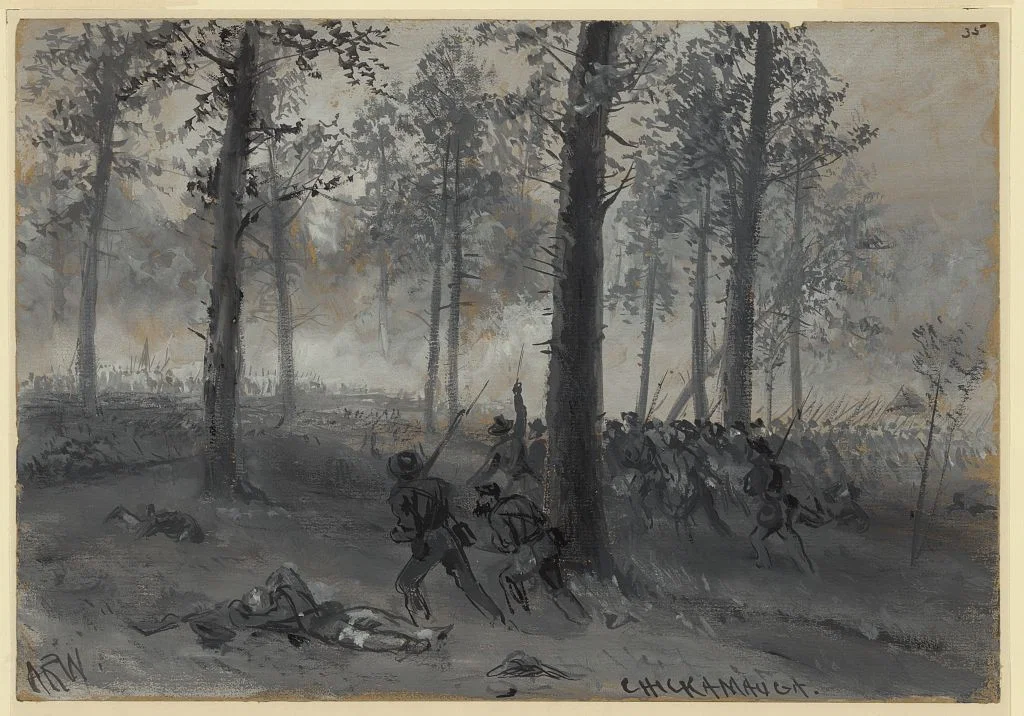
Bragg was determined to turn the Union left flank, and was willing to throw everything he had at it. "All through the day," writes historian James M. McPherson, "the rebels made savage division-sized attacks mostly against Thomas's corps through woods and undergrowth so thick that units could not see or cooperate with each other" (672). Both sides continued to pour more men into the bloody and chaotic fray, as the bodies piled up around the creek. Each rebel assault was repulsed with heavy losses, and although the Yankees succeeded in holding their ground, they were unable to mount any successful counterattacks. Thus, by the time nightfall put an end to the first day of battle around 6 p.m., a stalemate had settled over the field. While it is unknown how many soldiers fell on the first day, historian Peter Cozzens estimates that somewhere around 6,000 to 9,000 Confederates and 7,000 Federals were killed or wounded.
Bragg spent the evening reorganizing his forces. Longstreet's reinforcements had been filtering in throughout the day and, at 11 p.m., 'Old Pete' – as Longstreet was affectionately known by his friends – personally arrived at Bragg's headquarters, after briefly losing his way in the dark. Relieved, Bragg reorganized his army into two wings. Lt. General Leonidas Polk, the bishop-turned-soldier, would command the right wing and was ordered to renew the attack on the Federal left flank at daybreak. Longstreet was given command of the left wing and was told to attack in support of Polk; together, the two wings were to make a staggered, echelon attack, moving from right to left. Rosecrans, meanwhile, held his own council of war, in which he decided against retreat. Thomas's corps would continue to hold the vital left flank, with the other Union corps in support. All through the night, Thomas's engineers worked tirelessly to fortify their position with breastworks.
Second Day: 20 September
Once again, Bragg's carefully laid plans would be thwarted, not by the enemy but by the sluggishness of his subordinates. Despite being ordered to attack at dawn, Polk did not get his men moving until close to 9:30 a.m., more than four hours behind schedule. The delay would cost the Confederates dearly – at dawn, Thomas's breastworks had only been half-built, but by mid-morning, they had been transformed into formidable fortifications. Thus, when Polk finally made his assault, his soldiers were mowed down by Thomas's soldiers, firing safely from behind their breastworks. Until his death, Bragg would lament that the battle had not begun on schedule, claiming that if it had gone to plan, "our independence might have been won" (quoted in Cozzens, 338).
As the fighting gradually intensified on the Union left flank, Rosecrans began shifting reinforcements over to support Thomas. During this hectic process, Rosecrans was informed by a staff officer that a quarter-mile gap had opened on the right flank. Such a gap would leave the entire Union line exposed and would lead to calamity should it be exploited by a Confederate assault. So, Rosecrans ordered a division under Brigadier General Thomas Wood to move over and plug the gap. This was a mistake. There was no gap – the staff officer had simply failed to see the Union division concealed beneath the trees. Wood knew this but had already been berated twice during the campaign for not following orders. Against his better judgment, therefore, Wood moved his division to the right, thereby creating an actual gap in the Union line.
This was the decisive moment. Around the same time – 11:30 a.m. – Bragg cancelled the echelon order of attack, and ordered Longstreet to strike immediately. Old Pete dutifully obeyed, and his men charged forward – directly into the real gap created by Wood's movement. Longstreet's men, battle-hardened veterans all, recognized the opportunity for what it was. As more and more rebels poured into the breach, they began rolling up the exposed Union right flank. Before long, a full one-third of the Yankee army was in full, panicked retreat, running the 8 miles (13 km) back to Chattanooga. Rosecrans himself, alarmed by the breach in his lines, joined them, abandoning the battlefield. Longstreet knew that he was on the verge of breaking the entire Union army, and asked Bragg for reinforcements. Bragg, however, refused; he was loath to divert any troops from the hard-fought grapple with Thomas, which had been the focal point of the battle up until now. Longstreet was therefore forced to make do with the men he had.

But by the time Longstreet was able to call up his reserves, the moment had been lost. Thomas, thinking quickly, consolidated what Union forces remained on the field, hastily forming a new right flank on Horseshoe Ridge and Snodgrass Hill. Thomas's decision to stand his ground rather than join in the rout saved the Army of the Cumberland from complete destruction and cemented Thomas's reputation, earning him the nickname 'the Rock of Chickamauga'. Thomas was aided by Major General Gordon Granger, commander of the reserve division, who, on his own initiative, marched to support Thomas at a moment when much of the rest of the army was fleeing. Together, Thomas and Granger were able to hold off Longstreet's repeated and ferocious attacks until nightfall. It was only then, under the cover of darkness, that Thomas ordered his men to disengage and retreat, joining the rest of the army at Chattanooga.
Aftermath
When the sun rose on 21 September, Bragg stepped out of his headquarters, burdened by the weight of his victory. Although he had undoubtedly won the greatest Confederate victory in the western theater of the war, it had come at a horrific price – 20,000 men, or 30% of his entire fighting strength, had been killed, wounded, or gone missing in only two days. Ten of his subordinate generals had been killed or wounded, notably including General Hood, whose leg had to be amputated four inches below the hip. Bragg was greatly disturbed by these losses, compounded by the sight of the dead and dying carpeting the ground as thick as fallen leaves. When Longstreet and Major General Nathan Bedford Forrest urged him to press on and complete the destruction of Rosecrans' army, Bragg was unable to give the order.

The battered Army of the Cumberland, meanwhile, had limped back behind the safety of Chattanooga. It had also suffered greatly, losing 16,000 men killed, wounded, and missing (the total number of casualties, therefore, exceeded 35,000). Like his Southern counterpart, Rosecrans was shaken by the battle – yet rather than being awed by the sheer destruction of the fight, Rosecrans was instead shamed and embarrassed that he fled the field, leaving Thomas to clean up the mess. In the days after Chickamauga, Rosecrans acted – in the amusing words of President Lincoln – "confused and stunned, like a duck hit on the head" (quoted in McPherson, 675). It came as little surprise when, about a month later, Lincoln removed Rosecrans from command and replaced him with the more reliable General Thomas.
On 21 September, the day after the battle, Bragg finally got over his shock and marched to Chattanooga. Yet he was too late – he had not moved quickly enough to catch the Army of the Cumberland before it had had a chance to move behind the Chattanooga fortifications. Bragg had no choice but to lay siege, much to the consternation of his subordinates, who blamed him for not pressing the attack when he had the chance. The siege would culminate in the Battles of Chattanooga (23-25 November 1863), which would result in a major Confederate defeat. Chickamauga, therefore, was a stunning, yet ephemeral, victory for the Confederates, one that they would fail to exploit and would do little but buy them time before their next defeat.


