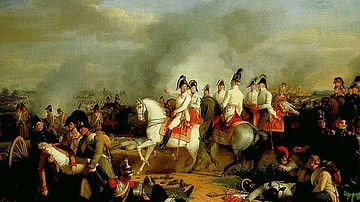

Frederick II of Prussia (1712-1786), better known as Frederick the Great, was one of the most consequential rulers of 18th-century Europe. A scion of the House of Hohenzollern, he came to power in 1740 at the age of 28 and, over the course of a 46-year reign, transformed Prussia from a third-rate backwater into one of the foremost European powers.
His military career spanned two major conflicts, the War of the Austrian Succession (1740-48) and the Seven Years' War (1756-1763), and included some of the most significant battles the Prussian army ever fought. Yet he was not just a military man; he was devoted to culture, particularly regarding music and the Enlightenment. In the centuries following his death in 1786, his legacy has undergone several revisions, and he has been alternatively viewed as a despicable autocrat, brilliant general, or Enlightened monarch.
Early Life
Frederick was born on 24 January 1712 in the Berlin Palace, in the Kingdom of Prussia. Prussia, at the time, was not the great power it was soon to become, but a third-rate backwater kingdom within the messy confines of the Holy Roman Empire. He was one of nine children born to King Frederick William I of Prussia (reign 1713-1740) and his wife, Sophia Dorothea of Hanover. For the first several years of his life, Frederick lived with his mother and elder sister Wilhelmine and was instructed by French tutors; his earliest memories were fond ones, filled with art, music, and leisure.
Then, around the age of 7, Frederick was plucked from this comfortable life and thrown into the cold, austere German world curated by his father. Known as the 'Soldier King', Frederick William I had transformed Prussia into a centralized, highly militaristic society. The young Frederick was subjected to a rigid schedule and expected to participate in masculine activities like hunting, riding, and shooting. Initially, the prince tried to show an interest in these things, but his father detested him for displaying 'effeminate' traits, such as wearing fashionable white gloves during a hunt, recoiling from the sound of gunfire, and his love of music and literature.
In 1726, Frederick was put in charge of a company of the king's own regiment, but embarrassed his father by falling off a horse during a military inspection. Frederick William responded to such failures by insulting his son and, at times, even beating him. In the summer of 1730, for instance, the king punched Frederick in the face, tore out clumps of his hair, and forced him to pass across the parade ground in this disheveled state to publicly humiliate him.
Eventually, Frederick had had enough. He had been looking forward to his arranged marriage to Princess Amelia of Great Britain, which would at least get him out from underneath his father's thumb. But once these marriage negotiations fell through, Frederick decided to take matters into his own hands. With the help of his friend – and possible lover – Lieutenant Hans Hermann von Katte, he tried to escape from Prussia on 5 August 1730. However, the pair was captured and imprisoned in Küstrin (Kostrzyn nad Odrą). Because he was an army officer caught trying to flee the country, Katte was charged with treason and beheaded on 6 November. Forced to watch, Frederick fainted as soon as the executioner's axe came down on Katte's neck.

Frederick William briefly toyed with the idea of having Frederick executed, too, or at least removing him from the line of succession. But he knew that either option would be difficult to justify to the Imperial Diet of the Holy Roman Empire. Frederick William was therefore forced to grant his son a full royal pardon on 18 November, although Frederick was not allowed to return to Berlin until February 1732. Having come so close to death and disgrace, Frederick was now determined to prove his worth. In April 1732, he was put in charge of an infantry regiment, whipping it into such good shape that Frederick William singled it out for praise two years later.
During the War of the Polish Succession (1733-1735), Frederick served under the distinguished general Prince Eugene of Savoy, from whom he learned much about military matters. In 1733, he dutifully married Elisabeth Christine of Brunswick-Wolfenbüttel. However, he had nothing in common with his new bride and expressed his frustration with the marriage by constantly ignoring and belittling her. By toeing the line in such a way, Frederick retained his position as crown prince, a move that would soon pay off. On 31 May 1740, Frederick William I died, and his 28-year-old son ascended the throne as Frederick II, King of Prussia.
First Campaigns: The Silesian Wars
Much like Frederick himself, Prussia was a young state with a lot to prove. In 1740, it had a weak economic base and consisted of several disjointed territories spread out across northern Europe, rendering it quite vulnerable. However, it compensated for these weaknesses with the fourth-largest army in Europe; indeed, the Prussian infantry, incessantly disciplined and drilled by Frederick's father, were already regarded as some of the best soldiers in the world. Though Frederick had detested military life as a boy, he recognized the army as a valuable tool to advance Prussia's standing and would soon get a chance to use it.
In October 1740, the death of the Holy Roman Emperor left the 23-year-old Maria Theresa on the Austrian throne. This caused controversy throughout the empire since, under the prevailing Salic Law, women could not inherit. Frederick allied himself with Maria Theresa's enemies and rejected her right to rule. His true aim, however, was the conquest of the Austrian province of Silesia, one of the wealthiest and most developed territories in Central Europe. He quickly mobilized his soldiers along the Silesian border and, on 16 December 1740, launched his invasion, igniting the conflict that would become known as the War of the Austrian Succession (1740-1748).

The Austrians were unprepared for Frederick's blitzkrieg, and within a matter of weeks, the Prussians had overrun Silesia. The following spring, Frederick met an Austrian army at the Battle of Mollwitz (10 April 1741), though his actions showed no indication that he would later be regarded as a military genius; indeed, partway through the battle, he fled the field to avoid capture. The battle was only won thanks to the well-disciplined Prussian infantry, who would later be praised by the tactician Carl von Clausewitz for achieving "a level of perfection in the use of firepower that has still not been surpassed" (quoted in Blanning, 103). Still, the Prussian victory at Mollwitz alarmed Maria Theresa, who quickly negotiated a truce with Frederick, ceding him Lower Silesia.
Unsatisfied, Frederick bided his time and rejoined the war in 1742, defeating another Austrian army at the Battle of Chotusitz (17 May 1742). The Austrians were once again obliged to seek peace, and this time ceded all of Silesia to Prussia. Emboldened by his easy past victories, Frederick was enticed to go to war with Austria for a third time in August 1744, invading Bohemia at the behest of France. The campaign was initially successful – on 16 September, Frederick captured Prague after a three-day bombardment.
But this time, the Prussian king had flown too close to the sun. Saxony joined the war on Austria's side, and, by early October, Frederick found he was being trailed by a massive Austro-Saxon army. With his own army ravaged by dysentery and starvation, Frederick was in no condition to fight and withdrew to Silesia, after 36,000 of his men had died from attrition. He spent the next few months preparing for the inevitable Austrian counteroffensive, which came in the spring of 1745.

Frederick surprised the enemy at their camp at the Battle of Hohenfriedberg (4 June 1745), in which he won a brilliant and decisive victory. He capitalized on this success by launching another invasion into Bohemia and beating the Austrians again at the Battle of Soor (30 September 1745). He made peace with Austria for a third time at the Treaty of Dresden – Austria agreed to uphold Frederick's conquest of Silesia, in exchange for Frederick's recognition of Maria Theresa as Austria's rightful ruler. After signing the treaty, Frederick returned to Berlin to great fanfare, where he was hailed for the first time as 'Frederick the Great'.
Winning Glory: The Seven Years' War
Despite his impressive victories, Frederick still felt insecure on the global stage. He was surrounded by enemies – Austria was eager to reclaim Silesia, while Saxony and Russia were nervous about Prussia's growing power and wanted to knock it down to size. Fearing that another war was imminent, Frederick negotiated an alliance with Great Britain. This prompted France to sign an alliance with Austria, a major political realignment known as the Diplomatic Revolution. Now, having secured British backing, Frederick was emboldened to take the initiative.
On 29 August 1756, he invaded Saxony and quickly occupied Dresden, kicking off the Seven Years' War (1756-1763) in Europe. Later that year, the Prussians marched into Bohemia and defeated the Austrians at the Battle of Lobositz (1 October 1756). The momentum soon fizzled out, however. Despite winning a pyrrhic victory at the bloody Battle of Prague (6 May 1757), Frederick was checked by an Austrian army a month later at Kolín (18 June). Losing around 14,000 men in the battle, he was forced to break off his invasion of Bohemia and withdraw to Silesia.

The end of 1757 saw Frederick regain some of his mojo, winning stunning victories over a Franco-Austrian army at the Battle of Rossbach (5 November) and over the Austrians at the Battle of Leuthen (5 December). But he was unable to obtain any kind of ceasefire from Maria Theresa, who was determined to keep fighting until she reclaimed Silesia. In 1758, Frederick tried to put increased pressure on Austria by invading Moravia, but he was forced to race back to Prussia when he learned that a Russian army had advanced within 100 miles (160 km) of Berlin.
The ensuing Battle of Zorndorf (25 August) left tens of thousands of men killed or wounded on each side but dealt enough damage to force the Russians to withdraw. Hardly pausing to rest, Frederick then marched into Saxony but was soundly beaten by the Austrians at the Battle of Hochkirch (14 October), widely regarded as the worst defeat of his career. The next year, the Prussians were defeated again at the Battle of Kunersdorf (12 August 1759) by an Austro-Russian army. Nearly half of Frederick's army was destroyed, and the Prussian king himself was nearly killed when a bullet lodged in a snuffbox he was carrying in his pocket. It seemed that for Frederick's enemies, the road to Berlin lay wide open.
Nevertheless, the Austro-Russian advance stalled, giving Frederick precious time to reorganize his defenses. The next couple of years resulted in a stalemate, with each side trying to gain the upper hand. Frederick, whose health had never been robust to begin with, was often ill during this period, and he suffered from bouts of melancholic despair; after his defeat at Kunersdorf, he apparently even considered suicide.

However, his luck would turn around in 1762 with the death of one of his bitterest enemies, Empress Elizabeth of Russia. Her successor, Peter III, was a Prussian sympathizer who admired their military and idolized Frederick. Peter soon withdrew Russia from the war, greatly weakening the anti-Prussia alliance. A year later, the Seven Years' War came to an end, restoring the prewar borders. By successfully defending Silesia in the face of overwhelming odds, Frederick retained Prussia's status as a great power. This came at a devastating cost, however, as Prussia had lost over 180,000 soldiers during the war.
Reigning Supreme: Poland & Bavaria
Having spent the first half of his reign establishing Prussia's dominance, Frederick's next task was to uphold this new status. To this end, he looked eastward, covetously eyeing the territories of the Polish-Lithuanian Commonwealth, which had recently been weakened by poor governance and economic strife. In 1769, Frederick sent his younger brother, Prince Henry, to Saint Petersburg to convince the new Russian empress, Catherine the Great, to agree to a joint partition of Poland. Once Catherine had assented, Frederick entreated his old enemy Maria Theresa to join the partition. The Austrian empress was reluctant but ultimately agreed; as Frederick put it, "she cries, but she takes."
In 1772, Poland was officially partitioned between the three powers. Frederick received the province of West Prussia, finally achieving his long-term goal of linking all his far-flung territories, thereby strengthening Prussia by giving it territorial cohesiveness. Despite this one-time alliance with Maria Theresa, Frederick continued to oppose Habsburg dominance in Germany. In 1778, he flexed his military power in the brief War of the Bavarian Succession, in which he opposed the meddling of Maria Theresa's son, Joseph II, in the affairs of Bavaria. Joseph II backed down before the war could escalate beyond minor skirmishing, once again affirming Prussia's newfound power in Central Europe.
Administration & the Arts
In September 1740, only a few months after he had ascended the throne, Frederick published an essay entitled Anti-Machiavel. Essentially a refutation of points made by the political theorist Niccolò Machiavelli, the essay sheds some light on Frederick's own beliefs on what it meant to be a king. For him, kingship was a sacred duty to both the state and to one's subjects. A king must be benevolent and must work tirelessly to advance the interests of the state and to defend his people, even at the expense of personal or dynastic goals. Though Frederick sometimes failed to live up to his own standards, he certainly took the idea of kingship seriously.

Indeed, this idea led him to become something of an autocrat, preferring to deal with most matters himself instead of relying on bureaucrats or other appointed officials. This style of ruling certainly had its disadvantages. As he got older, Frederick became increasingly conservative, dismissing out of hand any new ideas or reforms. Consequently, the Prussian government and army became overly rigid and stagnant toward the end of Frederick's reign, a problem that would not become apparent until the Napoleonic Wars, when it was too late.
Frederick took a great interest in civil law and was often influenced by Enlightenment ideals. He reformed the Prussian judicial system, abolishing the use of torture and ensuring that judges could only be appointed after passing a rigorous exam. His views on religion were also quite in keeping with the Enlightenment. He was probably a deist himself – indeed, he had once referred to Christianity as a 'metaphysical fiction' – but took pride in tolerating all religions within his kingdom. Of course, Protestants were still favored for government positions, but Jews and Catholics enjoyed greater religious freedoms in Prussia than in neighboring Protestant countries.
Frederick was also a great champion of the nobility, believing that the preservation of a distinct aristocratic class was necessary for Prussia's survival. As such, almost all government officials and army officers were nobles, with commoners having a much more difficult time achieving noble rank than under previous rulers. Frederick did not ignore the commoners, however. He often traversed the countryside, looking for ways to help farmers and improve Prussia's agricultural output. He drained swamps to create new farmlands and constructed canals to allow for the easier transportation of crops. To reduce the risk of famine, he encouraged farmers to diversify their crops and urged them to plant potatoes and turnips. For this, he was sometimes called the 'Potato King' (Der Kartoffelkönig).
He was a great lover of the arts, particularly music. An accomplished flutist, Frederick composed many original pieces of music, including 121 flute sonatas, four concertos for flute and strings, and three military marches. He was also known to write poetry – one such poem, likely written for his lover Francesco Algarotti, was entitled La Jouissance (loosely translated as 'the Orgasm'; poems like this contribute to the overwhelming amount of evidence that Frederick was likely gay). He loved literature and opera, although he detested German culture, which he viewed as underdeveloped and vulgar compared to French culture.
He was a great collector of art, particularly homoerotic works, and patronized the construction of several grand buildings in Berlin, including the Berlin State Opera and Prince Henry's Palace. He reinstated the Berlin Academy of Sciences and invited some of the most illustrious scholars in Europe to study there. Frederick also reached out to some of the great Enlightenment philosophers of his day. He offered shelter to Jean-Jacques Rousseau for several years and kept up a decades-long correspondence with Voltaire, although the two of them eventually fell out.

Death & Legacy
Toward the end of his life, Frederick spent most of his time isolated at his summer palace of Sanssouci, accompanied primarily by his Italian greyhound dogs. Constantly ill, his health gradually declined until his death on the morning of 17 August 1786, at the age of 74. Lacking any children of his own, he was succeeded by his nephew, Frederick William II, who has often been regarded as a weaker, less capable ruler.
Frederick's reign was quite consequential, changing the course of European history. He strengthened the position of Prussia on the global stage while simultaneously weakening the power of Austria and the Habsburg dynasty. The Austro-Prussian rivalry for control of Germany would continue until Austria's final defeat in 1866. As such, Frederick became a national hero and symbol of German unity, and was lionized by Adolf Hitler and the Nazi Party. Today, he is remembered as an effectual ruler, though many scholars question how many of his achievements are rightfully credited to him.