

| Rating: | |
|---|---|
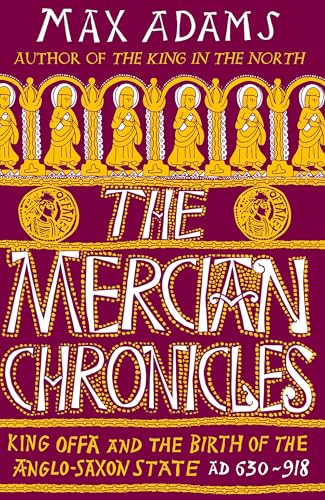
| Title: | Apollo The Mercian Chronicles King Offa and the Birth of the Anglo-Saxon State, AD 630918 (The Founders of Britain Quartet). |
| Author: | Max Adams |
| Audience: | General Public |
| Difficulty: | Easy |
| Publisher: | Apollo |
| Published: | 2025 |
| Pages: | 464 |
During the 8th century, Anglo-Saxon England was split into several kingdoms, the most powerful of which was Mercia. In an engaging and detailed new book, "The Mercian Chronicles," Max Adams explains how the Mercian kings were able to dominate the English Midlands and beyond.
“There was in Mercia in fairly recent times a certain vigorous king called Offa, who terrified all the neighbouring kings and provinces around him,” said Bishop Asser, a Welsh monk, in the 9th century, describing the peak of the “Mercian Supremacy” when the Midland kingdom dominated England. This high point of Mercian power is the subject of Max Adams’s latest book, The Mercian Chronicles: King Offa and the Birth of the Anglo-Saxon State, AD 630-918. Adams is an archaeologist and historian, previously of the University of Durham. He has written several books on Anglo-Saxon England, including King in the North (2013) – on the Kingdom of Northumbria in the 7th century – and Alfred’s Britain (2017) – on the Kingdom of Wessex and the creation of England in the 9th and 10th centuries. With its focus on the 8th century, The Mercian Chronicles bridges the gap between these two works.
The book is divided into three parts. Beginning with Mercia’s rise (630-716), which Adams credits to King Penda (reign 633-655), “the most successful warlord of his generation,” and the centralising impact of Christianity that was adopted by his sons. Mercia was also blessed with wide, navigable rivers and natural resources, allowing its kings and their underlings to enrich themselves through trade.
Part Two focuses on Mercia’s period of dominance over England (716-796), overseen by Aethelbald (reign 716-757) and Offa (reign 757-796), the ultimate “puppet master” of Anglo-Saxon politics. Through the use of military force, political opportunism, and compromising with local elites, they were able to consolidate Mercian power in the kingdoms of East Anglia, Essex, Sussex, Kent, and Wessex.
Part Three looks at Mercia’s decline (796-918), which resulted in the declining status of Mercian London as a trade hub and the rise of King Ecgbert of Wessex (regin 802-839), who conquered the wealthy Mercian-ruled Kingdom of Kent in 825. More deadly was Mercia’s inability to defend against the Vikings, who conquered the East Midlands in the 870s. Mercia’s western half survived but increasingly fell under the influence of Alfred the Great’s Wessex, before being annexed by the West Saxons in 918.
Alongside political history, Adams explores Mercian culture, social hierarchy, patronage networks, infrastructure, trade, landowners’ obligations, and royal administration. On Mercia’s most enduring building project, Offa’s Dyke – a linear earthwork across the Welsh border – rather than a military border to stop Welsh invasions, Adams views it as a symbol of Mercian power over the frontier and a deterrent to cattle raiders. Adams also proposes that the burghal (fortress) system – created by Alfred in the 9th century to enhance his defences and serve as regional centres of administration – had its roots in Offa’s Mercia, before being "appropriated" by Alfred.
The Mercian Chronicles’s focus on the 8th century is rare and refreshing. Other works on the Midland kingdom have often treated it as one of many equally essential periods in Mercian history, or have preferred to focus on Mercia’s contribution toward English unification. Thus, a detailed analysis of Mercia at the peak of its powers is most welcome.
However, the last century of the Mercian kingdom (821-918) is limited to a single chapter. While Adams has already covered this period in Alfred’s Britain, for those wanting a Mercian-focused account on the 9th and early 10th centuries, they will find Ian Walker’s Mercia and the Making of England (2000), a worthy sequel to The Mercian Chronicles.
Overall, Adams has provided a highly detailed and well-researched book on Mercia’s rise, its leading role in 8th-century England, and a guide to how power, kingship, and political culture functioned in early medieval Britain. Both a general audience and history students will find it a great introduction to an important and often neglected period of English history.
About the Reviewer

Related Content

Viking Raids in Britain

The Anglo-German Arms Race - Riding the Waves to WWI

Seven Kings Must Die Film - Historical Accuracy
Cite This Work
APA Style
McComb, M. (2025, October 20). The Mercian Chronicles: King Offa and the Birth of the Anglo-Saxon State, AD 630–918. World History Encyclopedia. https://www.worldhistory.org/review/536/the-mercian-chronicles/
Chicago Style
McComb, Michael. "The Mercian Chronicles: King Offa and the Birth of the Anglo-Saxon State, AD 630–918." World History Encyclopedia, October 20, 2025. https://www.worldhistory.org/review/536/the-mercian-chronicles/.
MLA Style
McComb, Michael. "The Mercian Chronicles: King Offa and the Birth of the Anglo-Saxon State, AD 630–918." World History Encyclopedia, 20 Oct 2025, https://www.worldhistory.org/review/536/the-mercian-chronicles/.
