


The Age of Sail (c. 1400–1860 CE) witnessed a dramatic expansion of long-distance maritime exploration, driven by commercial ambitions, imperial competition, strategic interests, and the pursuit of geographic knowledge. Powered by wind and increasingly sophisticated sailing ships, explorers relied on advances in shipbuilding, navigation, astronomy, and cartography to undertake unprecedented voyages across the Atlantic, Pacific, and Indian Oceans. From the Magellan–Elcano circumnavigation (1519–1522) to the great scientific expeditions of the 18th and 19th centuries, these voyages transformed humanity’s understanding of the planet. By the end of the period the age of wooden sailing ships gave way to steam propulsion, metal hulls, and modern naval technology.
These expeditions had consequences extending far beyond the discovery of new routes and coastlines. They accelerated global trade networks, supported the expansion of European colonial empires, and created unprecedented exchanges of plants, animals, technologies, and ideas between distant societies. Later voyages increasingly included astronomers, naturalists, and ethnographers, contributing to major advances in oceanography, biology, anthropology, and cartography.
About the Author
Related Images

Map of Arctic Discovery and Exploration

Antarctica: Discovery & Exploration - Mapping the Paths of Explorers Through a Continent of Ice
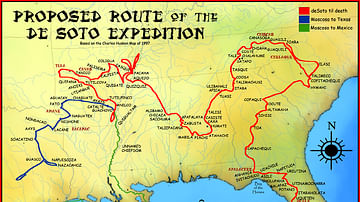
Route of the de Soto Expedition

Map of the Hanseatic League Trade Network, c. 1400

Map Showing William Dampier's 1699 Expedition Route

Ten Longest Reigns in History - Power Across Generations - Monarchs Who Ruled for Decades
Cite This Work
APA Style
Netchev, S. (2026, July 27). The Twelve Longest Discovery Expeditions in the Age of Sail: Exploration, Science, and the Expansion of Global Knowledge. World History Encyclopedia. https://www.worldhistory.org/image/21935/the-twelve-longest-discovery-expeditions-in-the-ag/
Chicago Style
Netchev, Simeon. "The Twelve Longest Discovery Expeditions in the Age of Sail: Exploration, Science, and the Expansion of Global Knowledge." World History Encyclopedia, July 27, 2026. https://www.worldhistory.org/image/21935/the-twelve-longest-discovery-expeditions-in-the-ag/.
MLA Style
Netchev, Simeon. "The Twelve Longest Discovery Expeditions in the Age of Sail: Exploration, Science, and the Expansion of Global Knowledge." World History Encyclopedia, 27 Jul 2026, https://www.worldhistory.org/image/21935/the-twelve-longest-discovery-expeditions-in-the-ag/.
