


The Roman Empire under Hadrian (reign 117–138 CE) marked a shift from the expansionism of Trajan toward consolidation, frontier security, and closer imperial administration. Hadrian inherited an empire at its greatest territorial extent, but he abandoned most of Trajan's recent conquests beyond the Euphrates and favored more defensible frontiers. His extensive journeys between 117 and 133 CE formed a central part of this policy, allowing him to inspect armies, reinforce frontier systems, engage directly with provincial communities, and project imperial authority across the empire.
- 117–118: Accession and Consolidation – beginning in the eastern provinces, Hadrian secured his position after Trajan's death, withdrew from the most exposed eastern conquests, inspected parts of Asia Minor and the Danube frontier, and returned to Rome to stabilize the new reign.
- 121–125: First Imperial Tour – Hadrian traveled through Gaul, the Rhine and Upper Danube frontiers, Britannia, Hispania, and North Africa, before continuing through the eastern provinces, Greece, and Sicily. This journey emphasized frontier inspection, military discipline, provincial administration, and direct contact with local communities. His visit to Britannia in 122 CE coincided with the construction of Hadrian's Wall.
- 128: African Military Inspection – Hadrian undertook a more focused journey to Africa Proconsularis, Numidia, and Mauretania, inspecting troops and frontier arrangements and demonstrating continued concern for military readiness and provincial order.
- 128–133: Second Eastern Tour – Hadrian traveled through Greece, Asia Minor, Syria, Arabia, Judaea, and Egypt, before returning by way of Asia Minor, Greece, and the Balkans. This journey combined frontier oversight with diplomacy, civic patronage, and cultural engagement. It included major activity in the Greek East, the foundation of Antinoopolis in Egypt, and visits to regions later affected by the Bar Kokhba Revolt (132–135 CE).
Hadrian's travels strengthened political and cultural links between Rome and the provinces while reinforcing the emperor's personal presence across the empire. A committed admirer of Greek culture, he gave particular patronage to Athens and supported civic, religious, and architectural projects across the Roman world, while major building also continued in Rome, including the rebuilding of the Pantheon. Taken together, these four journeys show how Hadrian governed not chiefly through further conquest, but through inspection, administration, diplomacy, frontier management, and cultural patronage.
About the Author
Related Images

Triumphal Entry of Germanicus into Rome

Map of the Limes in Rhineland-Palatinate, Germany

Map of the Hadrian’s First Imperial Tour, 121–125 CE - Frontier Inspection, Hadrian’s Wall and Provincial Rule

Map of the Hadrian’s wall (Vallum Hadriani) c. 122 CE

Map of the Journeys of Paul the Apostle, c. 46-63 CE - Spread of Early Christianity Across the Roman Mediterranean
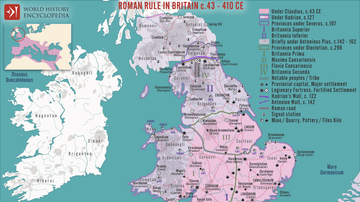
Map of the Roman Rule in Britain c. 43 - 410 CE - Four Centuries of Empire at the Edge of the World
Cite This Work
APA Style
Netchev, S. (2026, August 11). Map of Emperor Hadrian’s 4 Journeys Across the Roman Empire: Frontiers, Diplomacy & Imperial Power, 117–133 CE. World History Encyclopedia. https://www.worldhistory.org/image/14744/map-of-emperor-hadrians-4-journeys-across-the-roma/
Chicago Style
Netchev, Simeon. "Map of Emperor Hadrian’s 4 Journeys Across the Roman Empire: Frontiers, Diplomacy & Imperial Power, 117–133 CE." World History Encyclopedia, August 11, 2026. https://www.worldhistory.org/image/14744/map-of-emperor-hadrians-4-journeys-across-the-roma/.
MLA Style
Netchev, Simeon. "Map of Emperor Hadrian’s 4 Journeys Across the Roman Empire: Frontiers, Diplomacy & Imperial Power, 117–133 CE." World History Encyclopedia, 11 Aug 2026, https://www.worldhistory.org/image/14744/map-of-emperor-hadrians-4-journeys-across-the-roma/.
