
Search
Did you mean: Writing?
Remove Ads
Advertisement
Search Results

Article
The Mayan Pantheon: The Many Gods of the Maya
The pantheon of the Maya is a vast collection of deities worshipped throughout the regions of Yucatan, Quintana Roo, Campeche, Tabasco, and Chiapas in Mexico and southward through Guatemala, Belize, El...

Article
How an Adventure-loving American Saved the Thai Silk Industry
Bangkok was once more commonly known as the Venice of the East due to the intricate network of waterways that crisscrossed the city in the 19th century CE. There were few roads in the 1800s...

Definition
Minerva
Minerva was the Roman goddess of wisdom, medicine, commerce, handicrafts, poetry, the arts in general, and later, war. In many ways similar to the Greek goddess Athena, she had important temples in Rome and was patron of the Quinquatras...

Definition
Luddite
The Luddites, named after their legendary leader Ned Ludd, were workers who protested at the mechanization of the textile industry during the Industrial Revolution. From 1811 to 1816, the violent strategy of the Luddites was to smash...
Article
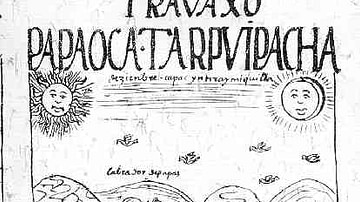
Daily Life in the Inca Empire
Daily life in the Inca empire was characterised by strong family relationships, agricultural labour, sometimes enforced state or military service for males, and occasional lighter moments of festivities to celebrate...

Article
Women's Work in Ancient Egypt
Women in ancient Egypt had greater rights than in any other civilization of the time. They could own land, initiate divorce, own and operate their own business, become scribes, priests, seers, dentists, and doctors...

Interview
Weavers, Scribes, and Kings: A New History of the Ancient Near East with Amanda H. Podany
In this interview, World History Encyclopedia sits down with author and Assyriologist Amanda H. Podany to learn all about her new book Weavers, Scribes, and Kings: A New...

Interview
Interview: Super/Natural: Textiles of the Andes
Over the course of several millennia, textiles were the primary form of aesthetic expression and communication for the diverse cultures that developed throughout the desert coasts and mountain highlands...
Image
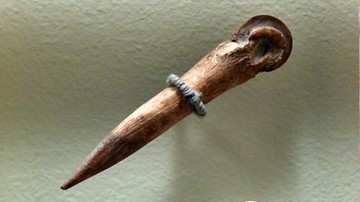
Bone Awls from Ain Ghazal
Bone awls polished to suit the purposes of weaving. They were also used for piecing and sewing leather. From Ain (Ayn) Ghazal, Amman, Jordan, Neolithic period, 10200-5000 BCE.
The Jordan Museum, Amman.

Definition
Medieval Guilds
Guilds of merchants and craft workers were formed in medieval Europe so that their members could benefit from mutual aid. Guilds ensured production standards were maintained and that competition was reduced. In addition, by members...
