
Search
Did you mean: Writing?
Remove Ads
Advertisement
Search Results

Article
Most Popular Gods & Goddesses of Ancient China
There were over 200 gods and goddesses worshipped throughout ancient China, but if one were to count every deity or spirit, the number would be over 1,000. Each town, village, city, field, farm, and sometimes...

Article
A Visual Who's Who of Greek Mythology
Achilles The hero of the Trojan War, leader of the Myrmidons, slayer of Hector and Greece's greatest warrior, who sadly came unstuck when Paris sent a flying arrow guided by Apollo, which caught him in his...

Article
The Debate Between Sheep and Grain - A Sumerian Argument Between Animal Husbandry & Agriculture
The Debate Between Sheep and Grain (circa 2000 BCE) is one of the best-known Sumerian literary debates in a genre that was popular entertainment by the late 3rd millennium...

Article
Inca Textiles
For the Incas finely worked and highly decorative textiles came to symbolize both wealth and status, fine cloth could be used as both a tax and currency, and the very best textiles became amongst the most prized of all possessions...
Article
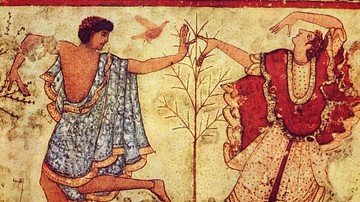
Etruscan Clothing
The clothing of the ancient Etruscans, a civilization which flourished in central Italy between the 8th and 3rd century BCE, can be seen in many media of their art including wall paintings, bronze sculpture, stone relief carvings...
Article
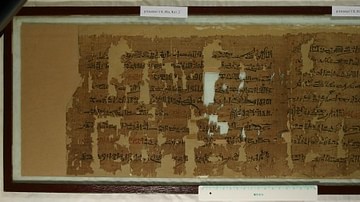
The Satire of the Trades
The literature of ancient Egypt is as rich and varied as any other culture. From the inscriptions of the Old Kingdom of Egypt (c. 2613-2181 BCE) through the Love Poems of the New Kingdom (c. 1570 - c. 1069 BCE) the Egyptian...

Article
Hipparchia the Cynic: Devoted Wife, Mother, & Outspoken Greek Philosopher
Cynic philosopher, wife of Crates of Thebes (l. c. 360 – 280 BCE), and mother of his children, Hipparchia of Maroneia (l. c. 350 – 280 BCE) defied social norms in order to live her...

Interview
Interview: Shung Ye Museum of Formosan Aborigines
Indigenous peoples of Austronesian ancestry are the original inhabitants of Taiwan. Taiwanese indigenous peoples — formerly called Taiwanese aborigines, Formosan people, and Gaoshan (臺灣原住民族) — lived...

Definition
Inca Civilization
The Inca civilization flourished in ancient Peru between c. 1400 and 1533 CE. The Inca Empire eventually extended across western South America from Quito in the north to Santiago in the south. It was the largest empire ever seen...

Definition
Byzantine Empire
The Byzantine Empire existed from 330 to 1453. It is often called the Eastern Roman Empire or simply Byzantium. The Byzantine capital was founded at Constantinople by Constantine I (r. 306-337). The Byzantine Empire varied in...
