
Search
Remove Ads
Advertisement
Search Results

Definition
Siddhartha Gautama
Siddhartha Gautama (better known as the Buddha, l. c. 563 - c. 483 BCE) was, according to legend, a Hindu prince who renounced his position and wealth to seek enlightenment as a spiritual ascetic, attained his goal and, in preaching...

Definition
Mandala
A mandala (Sanskrit for “circle”) is an artistic representation of higher thought and deeper meaning given as a geometric symbol used in spiritual, emotional, or psychological work to focus one's attention. The image first appears in...

Definition
Inca Architecture
Inca architecture includes some of the most finely worked stone structures from any ancient civilization. Inca buildings were almost always practical and pleasing to the eye. They are also remarkably uniform in design with even...

Definition
Nazca Civilization
The Nazca civilization flourished on the southern coast of Peru between 200 BCE and 600 CE. They settled in the Nazca and other surrounding valleys with their principal religious and urban sites being Cahuachi and Ventilla...
Definition
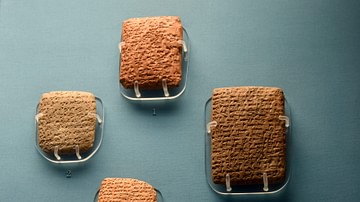
Amarna Letters
The Amarna Letters are a body of 14th-century BCE correspondence exchanged between the rulers of the Ancient Near East and Egypt. They are perhaps the earliest examples of international diplomacy while their most common subjects...

Definition
Theodosian Walls
The Theodosian Walls are the fortifications of Constantinople, capital of the Byzantine Empire, which were first built during the reign of Theodosius II (408-450 CE). Sometimes known as the Theodosian Long Walls, they built upon...

Definition
Phoenician Art
The art of the ancient Phoenicians, which flourished between the 19th and 4th centuries BCE, was exported throughout Mesopotamia and the ancient Mediterranean. Best known for their work on small decorative objects, Phoenician artists...

Definition
Carthaginian Government
The government of Carthage was based on a system of elected officials accountable to a popular assembly. Unlike its founding city, Tyre in Phoenicia, Carthage did not have a monarchy but its politics was dominated by an...

Definition
Unified Silla Kingdom
The Unified Silla Kingdom (668- 935 CE) was the first dynasty to rule over the whole of the Korean peninsula. After centuries of battles with the other states of the Three Kingdoms Period (57 BCE - 668 CE) Silla benefitted...

Definition
Samurai
The samurai (also bushi) were a class of warriors that arose in the 10th century in Japan and which performed military service until the 19th century. Elite and highly-trained soldiers adept at using both the bow and sword, the samurai...
