
Search
Did you mean: Tiye?
Remove Ads
Advertisement
Search Results

Definition
Silla
The Silla kingdom ruled south-eastern Korea during the Three Kingdoms period from the 1st century BCE to 7th century CE. The capital was Geumseong (Gyeongju) with a centralised government and hierarchical system of social ranks. The prosperity...
Definition
Esoteric Buddhism
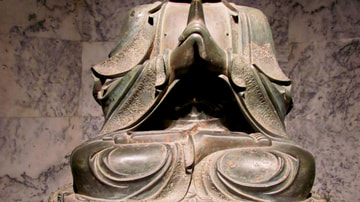
Esoteric Buddhism is the mystical interpretation and practice of the belief system founded by the Buddha (known as Sakyamuni Buddha, l. c. 563 - c. 483 BCE). It is known by several names and is characterized by a personal relationship...

Definition
Yongle Emperor
The Yongle Emperor (aka Chengzu or Yung Lo, r. 1403-1424 CE) was the third ruler of the Chinese Ming Dynasty (1368-1644 CE). Inheriting a stable state thanks to the work of his father, the Hongwu Emperor (r. 1368-1398 CE), Yongle...

Definition
Möngke Khan
Mongke Khan was ruler of the Mongol Empire (1206-1368 CE) from 1251 to 1259 CE. As the third Great Khan or 'universal ruler' of the Mongols, Mongke would oversee administrative reforms that continued to centralise government and ensure...

Definition
Yama
Yama is the Hindu god of death, king of ancestors, and final judge on the destination of souls. He is also known as the 'Restrainer', Pretaraja or 'King of Ghosts', Dharmaraja or 'King of Justice', and as Daksinasapati is considered the...

Definition
Unified Silla Kingdom
The Unified Silla Kingdom (668- 935 CE) was the first dynasty to rule over the whole of the Korean peninsula. After centuries of battles with the other states of the Three Kingdoms Period (57 BCE - 668 CE) Silla benefitted...

Definition
Dhammapada
Tipitaka (Sansktrit: Tripitaka), the Buddhist canon, consists of three pitaka (Tri means three and Pitaka refers to boxes), namely Vinaya or Monastic regimen, Sutta (Sanskrit: Sutra) or Discourses and Abhidhamma (Sanskrit: Abhidharma...
Image
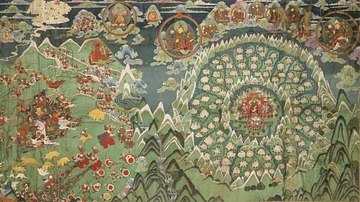
Kingdom of Shambhala
Kingdom of Shambhala and the Final Battle; Mongolia; 19th century; pigments on cotton; 44 x 87 1/2 in. (111.8 x 222.3 cm); Musée des arts asiatiques – Guimet, Paris; MG24416 (HAR 31352); photograph by Thierry Ollivier © RMN-Grand...
Image
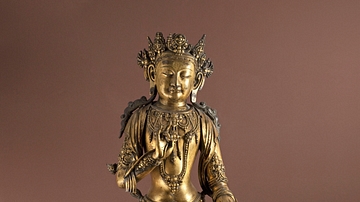
Bodhisattva with Yongle Reign Mark
Bodhisattva; probably Qutan Temple, Qinghai Province, China; Ming dynasty, Yongle reign mark (1403–1424 CE); gilt bronze; 53 1/2 x 26 x 17 7/10in. (136 x 66 x 45 cm); Musée Cernuschi, Asian Arts Museum of Paris...
Image
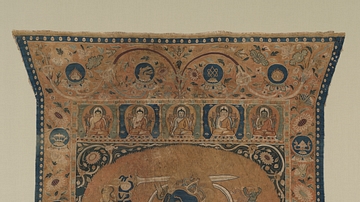
Achala, King of the Wrathful Ones
Achala, King of the Wrathful Ones; Inner Mongolia, Tangut Xia, Khara Khoto (1038–1227 CE); early 13th century CE; silk and pearls; overall: 40 1/4x 29 1/8 in. (102.3 x 74 cm); The Cleveland Museum of Art; purchase...
