
Search
Did you mean: Tiye?
Remove Ads
Advertisement
Search Results
Image
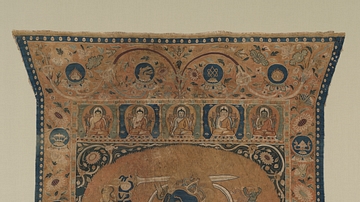
Achala, King of the Wrathful Ones
Achala, King of the Wrathful Ones; Inner Mongolia, Tangut Xia, Khara Khoto (1038–1227 CE); early 13th century CE; silk and pearls; overall: 40 1/4x 29 1/8 in. (102.3 x 74 cm); The Cleveland Museum of Art; purchase...
Image
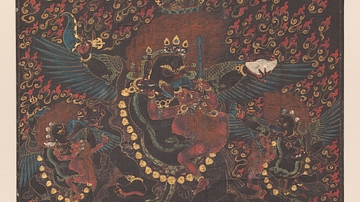
Raven-Headed Mahakala
Raven-Headed Mahakala; Bhutan; early to mid-19th century CE; pigments on cloth; 27 7/8 x 20 in. (70.8 x 50.8 cm); Rubin Museum of Art; C2006.42.8 (HAR 89189)
Image
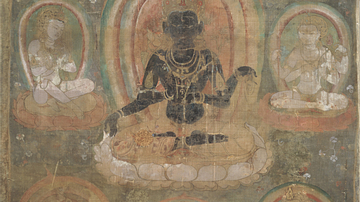
Deities of the Padmakula Mandala
Deities of the Padmakula Mandala; Dunhuang, China; period of Tibetan rule (781–848 CE); pigments on silk; 35 1/4 x 23 5/8 in. (89.6 x 60 cm); Musée des arts asiatiques – Guimet, Paris; Mission of Paul Pelliot, 1906–1908...
Image
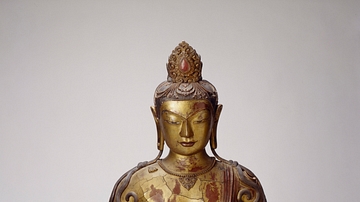
Buddha Amityaus
The Buddha Amityaus; possibly Chengde (Jehol), China; Qing dynasty, reign of the Qianlong Emperor (1736–1795 CE); hollow dry lacquer; 40 x 27 x 18 in. (101.6 x 68.6 x 45.7 cm); Asian Art Museum of San Francisco; The Avery Brundage...

Article
The Causes of WWI
The origins of the First World War (1914-18) are many and varied, with some even dating back several decades, but a political assassination in the Balkans in the summer of 1914 was the spark that blew up Europe's political powder...

Article
The Unicorn Myth
The unicorn, a mythical creature popularized in European folklore, has captivated the human imagination for over 2,000 years. For most of that time, well into the Middle Ages, people also believed them to be real. The roots of...

Article
The Seven Voyages of Zheng He
Admiral Zheng He (aka Cheng Ho, c. 1371-1433 CE) was a Chinese Muslim eunuch explorer who was sent by the Ming dynasty emperor Yongle (r. 1403-1424 CE) on seven diplomatic missions to increase trade and secure tribute...
Article
The Pre-WWI Alliance System - Triple Entente v. Triple Alliance
The alliance system in Europe was one of the causes of the First World War (1914-18), although it did not make war inevitable. In the first decade of the 20th century, the Triple Entente powers...
Article
Religious Developments in Ancient India
For well over 1,000 years, sacred stories and heroic epics have made up the mythology of Hinduism. Nothing in these complex yet colourful legends is fixed and firm. Pulsing with creation, destruction, love...

Article
Religion in the Mongol Empire
The Mongol Empire (1206-1368 CE) covered Asia from the Black Sea to the Korean peninsula and so naturally included all manner of religions within its borders, but the Mongols themselves had their own particular religious...
