
Search
Did you mean: Tiye?
Remove Ads
Advertisement
Search Results

Definition
Kublai Khan
Kublai Khan (Qubilai-Qan) was the ruler of the Mongol Empire from 1260 to 1294. His accomplishments include establishing Mongol rule in China under the name of the Yuan Dynasty (1271-1368), thus becoming the first non-Chinese to rule...

Definition
The Secret History of the Mongols
The Secret History of the Mongols is a chronicle written in the 13th century CE (with some later additions) and is the most important and oldest medieval Mongolian text. The book covers the origins of the Mongol...

Image
Initiation of Kublai Khan
Initiation of Kublai (Qubilai) Khan and Offering Tibet to Phakpa in 1264 CE; Tibet; c. 16th–17th century; pigments on cloth; 24 1/4 x 15 1/8 in. (61.5 x 38.4 cm); Rubin Museum of Art; C2002.3.2 (HAR 65046)

Article
Mongol Multiculturalism
The Mongol Empire accepted and promoted many other cultures. Historians often talk about cultural exchange across Asia in the Mongol Empire as something that was just facilitated by peace and stability across such a huge...

Interview
Interview: Bejeweled Sri Lanka
The first comprehensive survey of Sri Lankan art organized by an American museum, The Jeweled Isle: Art from Sri Lanka, on show now at the LACMA in Los Angeles, California, presents some 250 works addressing nearly...

Image
Tibetan Mandala, Sera Monastery
Tibetan Mandala painted in the Sera Monastery, about 2 km away from Lhasa, Tibet.
Image
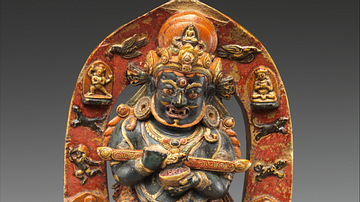
Panjaranatha Mahakala
Panjaranatha Mahakala; Tibet; 14th century CE; steatite with color and gilding; 7 x 4 1/2 x 1 1/2 in. (17.8 x 11.4 x 3.8 cm); The Metropolitan Museum of Art; gift of Florence and Herbert Irving, 2015; 2015.500.4.18

Image
Kublai Khan Naming Phakpa Imperial Preceptor
Kublai (Qubilai) Khan Naming Phakpa Imperial Preceptor, c. 1270 CE; attributed to Khyentse Chenmo (flourished 1450s–1490s CE); Tibet; late 15th–16th century CE; pigments on cloth; 32 1/4 x 20 in. (82.6 x...
Image
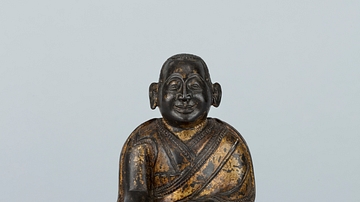
Lama Zhang
Lama Zhang (1123–1193 CE); Tibet; 14th century CE; bronze; 4.3 x 3.5 in. (11 x 9 cm); The Jacques Marchais Museum of Tibetan Art; 85.04.0650

Definition
Yuan Dynasty
The Yuan Dynasty was established by the Mongols and ruled China from 1271 to 1368. Their first emperor was Kublai Khan (r. 1260-1294) who finally defeated the Song Dynasty which had reigned in China since 960. Stability and peace...
