
Search
Did you mean: Thera?
Remove Ads
Advertisement
Search Results

Article
The Spice Trade & the Age of Exploration
One of the major motivating factors in the European Age of Exploration was the search for direct access to the highly lucrative Eastern spice trade. In the 15th century, spices came to Europe via the Middle East land and sea routes, and spices...

Article
The Hundred Years' War: Consequences & Effects
The Hundred Years' War was fought intermittently between England and France from 1337 to 1453 CE and the conflict had many consequences, both immediate and long-lasting. Besides the obvious death and destruction that many of the battles visited...

Article
The Life of Hercules in Myth & Legend
Hercules is the Roman name for the Greek hero Herakles, the most popular figure from ancient Greek mythology. Hercules was the son of Zeus, king of the gods, and the mortal woman Alcmene. Zeus, who was always chasing one woman or another...

Article
The Gold of the Conquistadors
The staggering quantity of gold the conquistadors extracted from the Americas allowed Spain to become the richest country in the world. The thirst for gold to pay for armies and gain personal enrichment resulted in waves of expeditions of...

Article
The Weapons of an English Medieval Knight
The weapons of an English medieval knight in combat included the long sword, wooden lance with an iron tip, metal-headed mace, battle-axe, and dagger. Trained since childhood and practised at tournaments, the skilled knight could inflict...

Article
The World's Oldest Love Poem - The Love Song for Shu-Sin
The world's oldest love poem is The Love Song for Shu-Sin (written circa 2000 BCE), composed in ancient Mesopotamia for use in part of the sacred rites of fertility. Prior to its discovery in the 19th century and its translation in the 20th...
Article
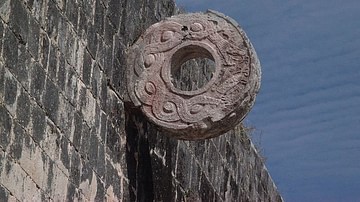
The Ball Game of Mesoamerica
The sport known simply as the Ball Game was played by all the major Mesoamerican civilizations and the impressive stone courts became a feature of many cities. More than just a game, it could have a religious significance and featured in...

Article
The Household Staff in an English Medieval Castle
An English medieval castle, if a large one, could have a household staff of at least 50 people, which included all manner of specialised and skilled workers such as cooks, grooms, carpenters, masons, falconers, and musicians, as well as a...

Article
The Temple of Hatshepsut
Among the duties of any Egyptian monarch was the construction of monumental building projects to honor the gods and preserve the memory of their reigns for eternity. These building projects were not just some grandiose gesture on the part...

Article
The Textile Industry in the British Industrial Revolution
During the Industrial Revolution (1760-1840), textile production was transformed from a cottage industry to a highly mechanised one where workers were present only to make sure the carding, spinning, and weaving machines never stopped. Driven...
