
Search
Did you mean: Thera?
Remove Ads
Advertisement
Search Results
Definition
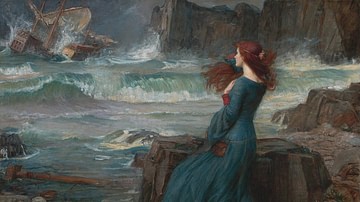
The Tempest - Shakespeare's Magical Tragicomedy
The Tempest is a play by William Shakespeare (c. 1564-1616), written in 1610 or 1611, and first performed for the court of James I of England (r. 1603-1625) on 2 November 1611. Believed to be the last play that Shakespeare wrote on his own...
Definition
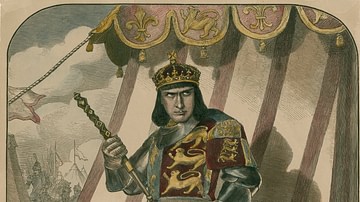
The Tragedy of Richard III - Shakespeare's First Great Villain
The Tragedy of Richard III, often referred to as simply Richard III, is a history play by William Shakespeare (1564-1616), probably written around 1592-94. It is the fourth and final installment of the 'first tetralogy' of Shakespeare's history...
Definition
The Eumenides
The Eumenides is a play written by Aeschylus (c 525 – 455 BCE), the “Father of Greek Tragedy,” the most popular and influential of all tragedians of his era. The Eumenides was the third play of a trilogy, The Oresteia, with the remaining...

Definition
The Westcar Papyrus
The ancient Egyptians enjoyed storytelling as one of their favorite pastimes. Inscriptions and images, as well as the number of stories produced, give evidence of a long history of the art of the story in Egypt dealing with subjects ranging...

Definition
The Barracks Emperors - Instability of Populist Rule
The "barracks emperors" is a term coined by later historians referring to the Roman emperors who were chosen and supported by the army during the period known as the Crisis of the Third Century (also known as the Imperial Crisis, 235-284...

Definition
The Frogs
The Frogs is a comedy play by Aristophanes (c. 445 - c. 385 BCE), the most famous of the comic playwrights of ancient Greece. Named after the creatures who composed the play's chorus, it won first prize at the dramatic festival at Lenaea...
Definition
The Clouds
The Clouds is a comedy written c. 423 BCE by the Greek playwright Aristophanes (c. 448 BCE – c. 385 BCE). A failure at the Dionysia competition, finishing third out of three, it was revised later in 418 BCE but never produced in the author's...

Definition
The Battle of Dun Nectain
The Battle of Dun Nechtain (also known as The Battle of Dunnichen, The Battle of Nechtanemere, Lin Garan, and The Battle of Nechtan) was a pivotal engagement between the Northumbrians under their king Ecgfrith and the Picts under the leadership...

Definition
The Battle of Abritus - Historic Gothic Victory Over Rome
The Battle of Abritus was an engagement fought between the armies of Rome under Emperor Decius (reign 249-251) and a coalition of Goths under the leadership of Cniva (circa 250 to circa 270?) in 251, resulting in a victory for Cniva and the...

Definition
The Wasps
The Wasps is a play written by the lone representative of Ancient Greece's Old Attic Comedy, Aristophanes (c. 445 - c. 386 BCE). It won second place at the Lenaea competition in 422 BCE. Written in two acts, the play focuses on a reoccurring...
