
Search
Did you mean: Epona?
Remove Ads
Advertisement
Search Results
Image
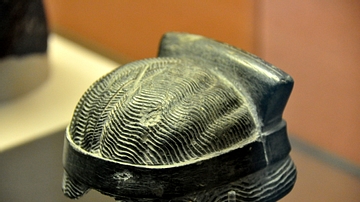
Stone Hair and Headdress of the God Lamma
On the back of this piece, there are cuneiform inscriptions that mention that this headdress was commissioned by a Bau-Ninam on behalf of King Shulgi of Ur. It is most likely that this headdress was to be put...
Image
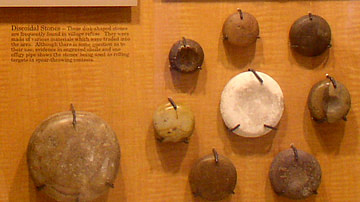
Stone Discoidals Found at the Plaquemine Mississippian Winterville Site
Ground discoidal stones used in the Native American game of chunkey (Tchung-kee), found at the Winterville Site, Mississippi, USA.
Image
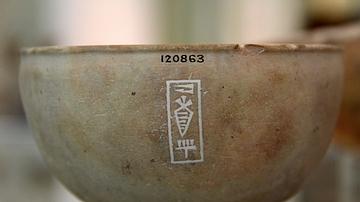
Stone Bowl Inscribed with the Name of Agirgal
Agirgal was probably the name of the owner of the bowl. It was found in grave PG33. Akkadian to Neo-Sumerian Period, 2300-2100 BCE. From the Royal Cemetery at Ur, Southern Mesopotamia, modern-day Iraq...
Image
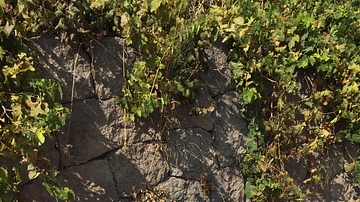
Stone Coffin, Smyrna
This coffin was part of a larger necropolis in "Old Smyrna" (established in the 11th century BCE) and is believed to be from the 7th or 6th century BCE. The necropolis contained the remains of nobles who died after the attack...

Image
Stone Ruins from Arates Monastery in Armenia
Arates Monastery in Armenia is built on top of a hill and overlooks the Arates tributary of the Yeghegis River. The monastery's name came from the combination of “ari” ("come" in Armenian) and “tes” ("see"...

Definition
Sun Stone
The Aztec Sun Stone (or Calendar Stone) depicts the five consecutive worlds of the sun from Aztec mythology. The stone is not, therefore, in any sense a functioning calendar, but rather it is an elaborately carved solar disk, which...

Definition
Rosetta Stone
The Rosetta Stone is an incomplete grey and pink granodiorite stela dating from 196 BCE which presents a priestly decree concerning King Ptolemy V of Egypt. The text is in three different versions: Hieroglyphic, Demotic and Greek...

Video
Stone Circles of Senegambia (UNESCO/NHK)
The site consists of four large groups of stone circles that represent an extraordinary concentration of over 1,000 monuments in a band 100 km wide along some 350 km of the River Gambia. The four groups, Sine...
Article
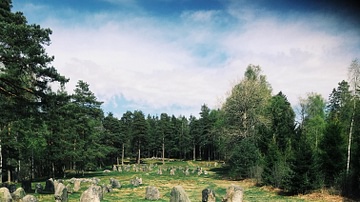
Exploring Norways' Forgotten Stone Circles & Petroglyphs
Right outside the cities of Fredrikstad and Sarpsborg in South-East Norway, there are two archaeological, intriguing and beautiful sites, the Hunnfelt, a monument consisting of several stone circles...

Article
The Tizoc Stone
The Tizoc Stone is a huge stone cylinder from the Aztec capital of Tenochtitlan which depicts a sun-disk on its flat upper surface and carries a frieze around its outer edge showing Aztec warriors and the Aztec king Tizoc, whose...
