
Search
Did you mean: Epona?
Remove Ads
Advertisement
Search Results

Image
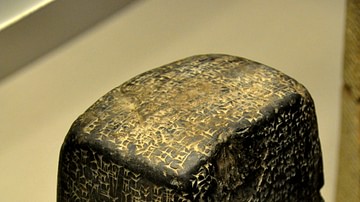
Stone Monument of Esarhaddon
Irregular rectangular-sided monument recording Esarhaddon's restoration of Babylon; possibly black basalt; carved symbols on the upper surface. Height 8.5 inches. The stone is not local to Mesopotamia. The irregular...
Image
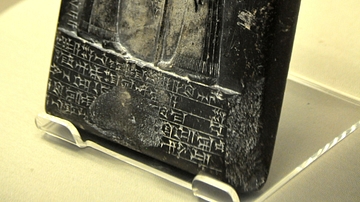
Stone Foundation Document of King Adad-Nirari I
Rectangular stone foundation document of the Assyrian king Adad-Nirari I. It recounts the king's victories over the Mitanni, who had failed to gain Hittite support, and the extension of Assyrian rule...
Image
Stone tablet of Nabu-apla-iddina
This stone tablet records the restoration of certain lands by the Babylonian king Nabu-apla-iddina to a priest. On the top of the stone are 13 symbols of the gods designed to protect the legal statement. Both the...
Image
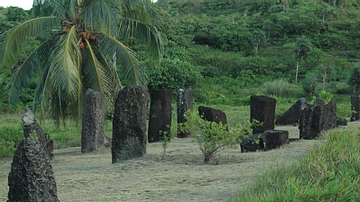
Stone Face Monoliths of Palau
Considering Palau’s Earthwork Era (c. 450 BC to AD 850), the Badrulchau stone monoliths can be dated to c. 161 CE and are part of the thirty-eight monoliths on the islands of Babledaob and Oreor (Koror), twenty-eight...

Image
Stone Ramparts of the Inner Ward at Hara Castle
Stone ramparts of the inner ward at Hara Castle, photograph by Matthew Allison, 4 October 2025. Unlike much of Hara Castle at the end of the Shimabara Rebellion, the ishigaki (stone ramparts) that form...

Image
Stone Statues Overlook the Ariake Sea at Hara Castle
Stone statues overlook the Ariake Sea at Hara Castle, photograph by Matthew Allison, 4 October 2025. At the highest point of Hara Castle, where the inner ward housing the Shimabara Rebellion's leaders...

Image
Stone Stele & 1,000 Characters of Happiness, Great Wall of China
The stone stele stands in front of the wall of the One Thousand Characters of Happiness near the entrance to the Great Wall of China. The 1,000 Characters of Happiness is a fascinating display...

Image
Stone Turtle, Karakorum
A stone turtle at Karakorum, Mongolia, from the khan's palace there. The city was made capital of the Mongol Empire in 1235 CE by Ogedei Khan (r. 1229-1242 CE).
Image
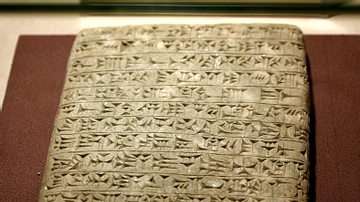
Stone Tablet of Queen Yaba
This stone tablet was found in a niche into the right-hand wall of the space leading to the burial chamber of Tomb II (one of the vaulted burial chambers of the so-called Queens' Tombs inside the North-West Palace at Nimrud...

Image
Stone of Destiny, Hill of Tara
The Neolithic Lia Fail (Stone of Destiny), Hill of Tara, County Meath, Ireland, by which the ancient kings were inaugurated.
