
Search
Remove Ads
Advertisement
Search Results

Article
Medieval Knights: 12 of the Best
The knights of medieval Europe were meant to be the finest fighting men of their age, even more important, they were expected to be pure in thought and deed, as exemplified in the chivalrous code which they (usually...
Article
Famous Grammarians & Poets of the Byzantine Empire
In the wake of the downfall of the Western Roman Empire and the intellectual collapse of Athens, Byzantine scholars engaged in preserving the Classical Greek language and its literature. Thus they became...

Article
The Death of David 'Davy' Crockett at the Alamo - José Enrique de la Peña's Account of the Surrender
The death of David 'Davy' Crockett at the Battle of the Alamo (6 March 1836) has been understood as a heroic last stand at least since 1880 when Texan historian...

Definition
Tyche
In Greek mythology, Tyche is the goddess and personification of good luck, chance, and fortune. Tyche's popularity grew after the Classical period when many cities and officials across the Greek world and the Mediterranean adopted her...

Definition
Statue of Zeus at Olympia
The monumental statue of Zeus at Olympia in Greece was one of the Seven Wonders of the Ancient World. Created in the 430s BCE under the supervision of the master Greek sculptor Phidias, the huge ivory and gold statue was...

Definition
Cochineal
Cochineal is a brilliant red dye extracted from the crushed bodies of parasitic insects which prey on cacti in the warmer parts of the Americas. The dye was an important part of trade in ancient Mesoamerica and South America and throughout...
Definition
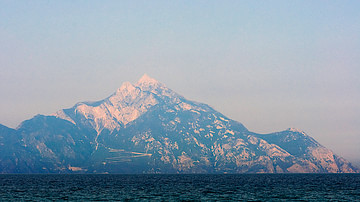
Mount Athos - The Byzantine Holy Mountain
Mount Athos, located on the Chalkidike peninsula near Thessalonica, Greece, is a holy site which first saw hermit monks living there in the 9th century CE. Regarded as one of the most important monastic sites...

Definition
Corpus Juris Civilis - The Justinian Law Code
The Justinian Code or Corpus Juris Civilis (Corpus of Civil Law) was a major reform of Byzantine law created by Emperor Justinian I (r. 527-565 CE) in 528-9 CE. Aiming to clarify and update the old Roman...

Definition
Roman Empire
The Roman Empire, at its height (c. 117), was the most extensive political and social structure in western civilization. Building upon the foundation laid by the Roman Republic, the empire became the largest and most powerful political...

Definition
Tsar
Tsar (also czar) is a Slavic term derived from the Latin caesar. Ivan III (Ivan the Great) (r. 1462-1505) was the first Russian ruler to begin using the title of tsar during his reign instead of the title Grand Prince of Moscow. His grandson...
