
Search
Did you mean: Anubis?
Remove Ads
Advertisement
Search Results

Definition
Hatshepsut
Hatshepsut (r. 1479-1458 BCE) was the first female ruler of ancient Egypt to reign as a male with the full authority of pharaoh. Her name means "Foremost of Noble Women" or "She is First Among Noble Women". She began her reign as...

Definition
Ergamenes
King Ergamenes (also known as King Arkamani I, r. 295-275 BCE) was the greatest king of the city of Meroe, Kingdom of Kush (located in modern-day Sudan) who broke free from Egyptian dominance to help direct a wholly distinct culture...

Article
Setna II: A Detailed Summary & Commentary
Setna II (also Setna Khaemaus and Si-Osire) is a work of ancient Egyptian literature from Roman Egypt (30 BCE - 646 CE) written in demotic script. It is part of a cycle of stories known as the Tales of Prince...

Definition
Ancient Egypt - The Land of the Gods of Balance and Harmony
Egypt is a country in North Africa, on the Mediterranean Sea, and is home to one of the oldest civilizations on Earth. The name "Egypt" comes from the Greek Aegyptos, which was the Greek pronunciation...

Definition
Kingdom of Axum
The African kingdom of Axum (also Aksum) was located on the northern edge of the highland zone of the Red Sea coast, just above the horn of Africa. It was founded in the 1st century CE, flourished from the 3rd to 6th century CE...

Definition
Ptolemaic Dynasty
The Ptolemaic dynasty was a Macedonian royal family that ruled Ptolemaic Egypt from 323 to 30 BCE. It was founded by Ptolemy I, a general and successor of Alexander the Great. They built Alexandria, including the Lighthouse of...

Definition
Ashurbanipal
Ashurbanipal (r. 668-627 BCE, also known as Assurbanipal) was the last of the great kings of Assyria. His name means "the god Ashur is creator of an heir" and he was the son of King Esarhaddon of the Neo-Assyrian Empire. In the Hebrew...

Definition
Late Period of Ancient Egypt - The End of Egyptian Rule of Egypt
The Late Period of Egypt (525-332 BCE) is the era following the Third Intermediate Period (1069-525) and preceding the brief Hellenistic period (332-323 BCE) when Egypt was ruled by the Argead...
Image
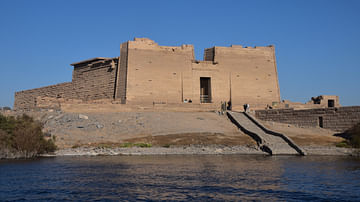
Temple of Mandulis, New Kalabsha
The Temple of Mandulis (also known as the Temple of Kalabsha) is a Roman Period Egyptian temple built as a tribute to Mandulis, a sun god of ancient Nubia. It was constructed by Emperor Augustus around 30 BCE, presumably...

Article
The Spread of Islam in Ancient Africa
Following the conquest of North Africa by Muslim Arabs in the 7th century CE, Islam spread throughout West Africa via merchants, traders, scholars, and missionaries, that is largely through peaceful means whereby...
