
Search
Did you mean: Anubis?
Remove Ads
Advertisement
Search Results
Image
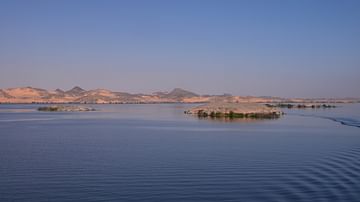
Lake Nasser, Egypt
Lake Nasser (also known as Lake Nubia) is a vast reservoir on the Nile River in southern Egypt and northern Sudan. It was created by the impounding of the Nile’s waters by the Aswan High Dam, which was built in the 1960s. It...
Image
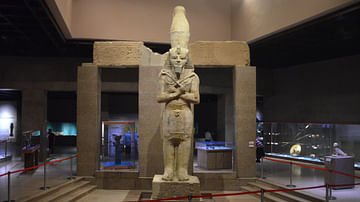
Ramesses II from Gerf Hussein
Statue of Ramesses II (r. 1279-1213 BCE), one of several such figures that acted as pillars in the forecourt of the temple of Gerf Hussein in Nubia. The temple, dedicated to Ptah and Hathor and built by Setau, Viceroy...

Image
Anklet
Period: Meroitic Period Date: 100–250 CE Geography: From Egypt and Sudan, Nubia, Gebel Faras, Cemetery 1, Grave 186, Oxford Univ. Exped. 1926 Medium: cupreous alloy Dimensions: Diam. 11 cm (4 5/16 in) Credit Line: Gift of Oxford...

Article
Queen Hatshepsut: Daughter of Amun, Pharaoh of Egypt
Hatshepsut, whose name means "Foremost of Noble Women" or "First Among Noble Women" (royal name, Ma'at-ka-re, translated as "spirit of harmony and truth") was the fifth ruler of the 18th Dynasty (r...

Article
Conflict Between the Temple and the Crown in Ancient Egypt
The gods of ancient Egypt were worshipped as the creators and sustainers of all life. People acknowledged their supremacy and intimacy daily through rituals, amulets, and their labor for the king...
Image
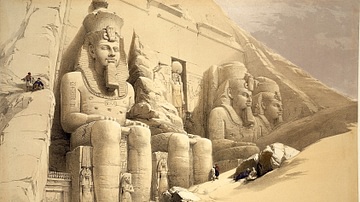
Statues Outside the Temple of Abu Simbel
Statues outside the temple of Abu Simbel, Egypt. Coloured lithograph by Louis Haghe after David Roberts, 1849 CE. Wellcome Collection, London. David Roberts travelled in the Middle East and North Africa...
Image
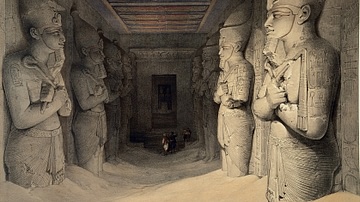
Statues Inside the Temple of Abu Simbel
Statues inside the temple of Abu Simbel, Egypt. Coloured lithograph by Louis Haghe after David Roberts, 1849 CE. Wellcome Collection, London. David Roberts travelled in the Middle East and North Africa, particularly...

Definition
The Candaces of Meroe
The Candaces of Meroe were the queens of the Kingdom of Kush who ruled from the city of Meroe c. 284 BCE-c. 314 CE - a number of whom ruled independently c. 170 BCE-c. 314 CE - in what is now Sudan. The title Candace is the...

Image
Abu Simbel, Sanctuary of the Temple of Ramesses II
In the sanctuary inside the Temple of Ramesses II (Great Temple) at Abu Simbel are rock-cut sculptures of four seated figures: Ra-Horakhty, the deified king Ramesses, and the gods Amun Ra and Ptah...
Image
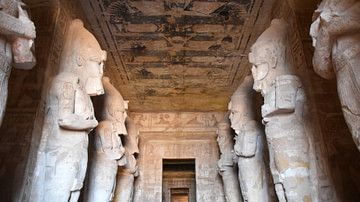
Abu Simbel, Interior of the Temple of Ramesses II
The hypostyle hall of the Temple of Ramesses II at Abu Simbel is 18 m (59 ft) long and 16.7 m (55 ft) wide and is supported by eight massive pillars depicting the deified Ramesses linked to the god Osiris...
