
Search
Did you mean: Anubis?
Remove Ads
Advertisement
Search Results
Image
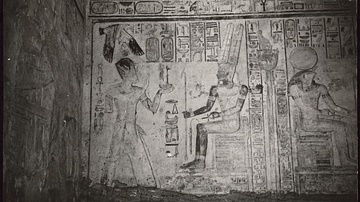
Bas-Relief Inscriptions at Abu Simbel Great Temple
Great Temple (height: 110 feet / 33 meters, width: 127 feet / 38 meters) built under the 19th dynasty. On the facade, four colossuses about 67 feet / 20 meters high represent Rameses II (1290-1223 BCE...
Image
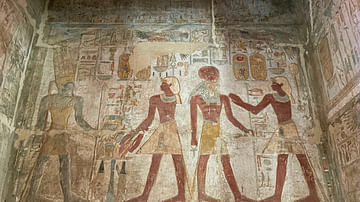
Amenhotep II & Thutmose III offering to Amun-Ra & Ra-Harachte
Relief in the Temple of Amada depicting Amenhotep II (1427-1401 BCE) making an offering to Amun-Ra while his father on the right Thutmose III (r. 1458-1425 BCE) makes an offering to Ra-Harachte...
Image
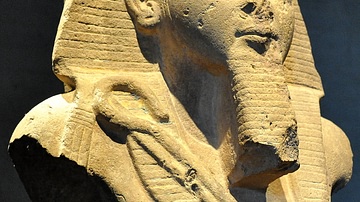
Nubian Statue of Ramesses II
Sandstone statue of the upper half of the seated figure of the Egyptian pharaoh Ramesses II. The lower half is lost. The king holds a crook and a flail. From Nubia, modern-day lower Egyptian and upper Sudanese areas...

Image
Scaffolding Arch of Abu Simbel Great Temple, 1966
International campaign for the safeguarding of the Nubian monuments launched by UNESCO. In this photo, you can see the first arch of the scaffolding for the dome of the Great Temple of Abu Simbel under...

Image
Temple of Hathor, Abu Simbel
Temple of Hathor or "Small Temple" - constructed during the 19th Dynasty. On the facade, six colossuses represent Rameses II (1290-1223 BCE) and his wife, Queen Nefertari, shown as the Goddess Hathor. Alongside each...
Image
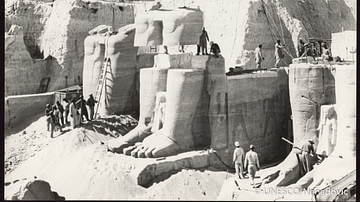
Dismantling of Abu Simbel Statues, 1966
Dismantling of the statues of the Great Temple at Abu Simbel during the International Campaign for the Safeguard of the Nubian Monuments launched by UNESCO.
Abu Simbel, Egypt, Nubia (9 February 1966)
Image
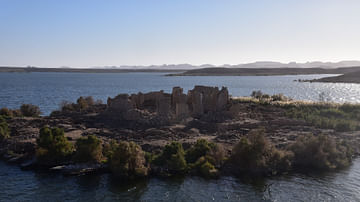
Qasr Ibrim, Egypt
Qasr Ibrim is the site of a fortress in Lower Nubia, Egypt. Throughout its long history, ranging from as early as 1000 BCE to 1813 CE, it controlled the traffic on the river and routes through the eastern desert. It is the only...
Image
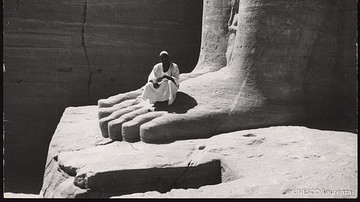
Giant Foot at Abu Simbel
Great Temple (height: 110 feet / 33 meters, width: 127 feet / 38 meters) built under the 19th dynasty. On the facade, four colossuses about 67 feet / 20 meters high represent Rameses II (1290-1223 BCE). The complete work...
Image
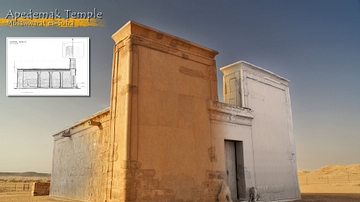
Apedemak Temple
Lion Temple to the Nubian deity Apedemak in Musawwarat (modern-day Sudan). Apedemak was worshipped in Nubia by Meroitic peoples, and Musawwarat appears to have been its central temple. The deity had only a small influence...
Image
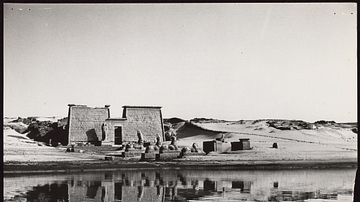
Temple of Amun Ra and Ra Harmakhis
This temple was constructed in the Valley of the Lions by Ramesses II (c. 1250 BCE) in honour of the gods Amun Ra and Ra Harmakhis. The back of the temple is hollowed out in the rock. In the foreground stands the...
