
Search
Remove Ads
Advertisement
Search Results

Definition
Odysseus
Odysseus (Roman name: Ulysses) was one of the great pan-Hellenic heroes of Greek mythology. He was famous for his courage, intelligence, and leadership. Odysseus' resourcefulness and oratory skills were instrumental in the Greek victory...

Definition
Isthmia
Isthmia is a genitive noun with the meaning 'of the Isthmus.' It generally refers to the site that held the famous Isthmian Games near Corinth on the Isthmus. A natural assembly place for many Greeks and travellers. Isthmia in Antiquity...

Definition
Samothrace
Samothrace (Samothrake) is a Greek island in the northern Aegean which was prominent from the Classical period as a member of the Delian League. Its greatest claim to fame was as a cult centre favoured by Macedon and visited by pilgrims...

Definition
Pan Flute
The pan flute or panpipes (syrinx) was a musical wind instrument first used by the ancient Greeks. Most commonly played by shepherds, the earliest use was in the Cycladic islands in the third millennium BCE, and representations of...
Definition
Vetulonia
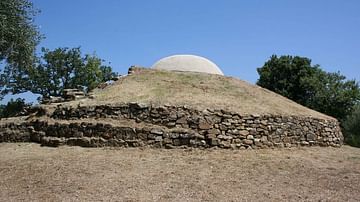
Vetulonia (Etruscan: Vetluna), located in the hills near the western coast of central Italy, was an important Etruscan town from the 9th to 3rd century BCE. The site has many impressive tumulus tombs which were rich in artefacts illustrating...

Definition
Olmec Civilization
The Olmec civilization, located in ancient Mexico, prospered in Pre-Classical (Formative) Mesoamerica from c. 1200 BCE to c. 400 BCE. Monumental sacred complexes, massive stone sculptures, ball games, the drinking of chocolate...

Definition
Ghana Empire
The Ghana Empire flourished in West Africa from at least the 6th to 13th century. Not connected geographically to the modern state of Ghana, the Ghana Empire was located in the western Sudan savannah region (modern southern Mauritania...

Definition
Prometheus
In Greek mythology, the Titan Prometheus had a reputation as being something of a clever trickster and he famously gave the human race the gift of fire and the skill of metalwork, an action for which he was punished by Zeus, who ensured...

Definition
Hecate
Hecate (Hekate) is a goddess of Greek mythology capable of both good and evil. She was associated with witchcraft, magic, the Moon, doorways, and creatures of the night like hell-hounds and ghosts. Hecate often carries a torch in her...

Definition
Byzantine Art
Byzantine art (4th - 15th century CE) is generally characterised by a move away from the naturalism of the Classical tradition towards the more abstract and universal, there is a definite preference for two-dimensional representations...
