
Search
Remove Ads
Advertisement
Search Results

Image
Libyco-Punic Mausoleum of Dougga
Ruins of the Libyco-Punic Mausoleum in Dougga, photograph by Carole Raddato, Tunisia, 04 October, 2024. The Libyco-Punic Mausoleum is a remarkable 21-metre-high 2nd-century BCE royal tomb. The monument is divided...

Image
Statue of a Horse from the Mausoleum at Halicarnassus
This is a forepart of a horse from the chariot-group surmounting the Mausoleum at Halicarnassus, also known as the Tomb of Mausolus . From the north side of the peribolus wall of the Mausoleum. Classical...
Image
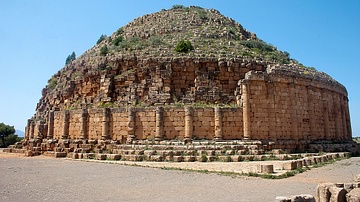
Royal Mausoleum of Mauretania
The Royal Mausoleum of Mauretania in Tipaza, Algeria was built in 3 BCE by Juba II of Numidia (c. 50 BCE – c. 25 CE) and his wife Cleopatra Selene II (40 BCE – c. 5 BCE). This tomb may have been the final resting place...

Image
Royal Mausoleum of Mauretania, Algeria
The Royal Mausoleum of Mauretania near Tipasa in Algeria is a funerary monument built in 3 BCE by Juba II of Numidia (c. 50 BCE- c. 25 CE) and his wife Cleopatra Selene II (40 BCE-c. 5 BCE). This tomb may have...
Image
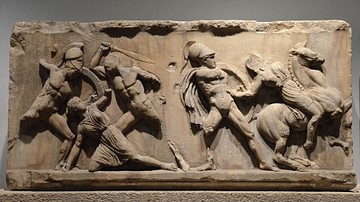
Amazonomachy Relief from the Mausoleum at Halicarnassus
Slab from the Amazonomachy frieze depicting five figures, three Greeks and two Amazons, and a horse. From the Mausoleum at Halicarnassus, around 350 BCE (British Museum).
Image
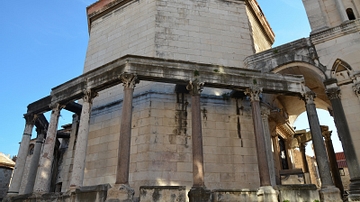
Diocletian's Mausoleum
The octagonal mausoleum of Diocletian (now Cathedral of St. Domnius) inside Diocletian's Palace, Split (Croatia). Diocletian's Palace was built between 293-303 CE in preparation for his retirement on 1 May 305 CE.
Image
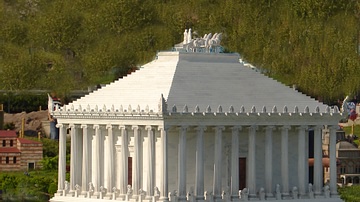
Model of the Mausoleum at Halicarnassus
A modern scale model of what the 4th century BCE Mausoleum at Halicarnassus may have looked like, one of the Seven Wonders of the world. (Miniatuk, Istanbul)
Image
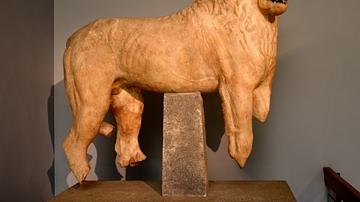
Marble Lion, Mausoleum at Halicarnassus
This is the most complete of the surviving lions from the Mausoleum at Halicarnassus, also known as the Tomb of Mausolus. The lions probably stood at the base of the stepped-pyramid roof, acting as both protective...

Image
The Centaur Frieze of the Mausoleum at Halicarnassus
This is a marble slab of the so-called Centaur frieze of the Mausoleum at Halicarnassus, also known as the Tomb of Mausolus. The whole frieze depicts a violent conflict between Greeks and Centaurs...
Image
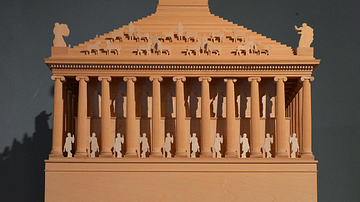
Model of the Mausoleum of Halicarnassus
Model of the Mausoleum of Halicarnassus.
