
Search
Did you mean: Marduk?
Remove Ads
Advertisement
Search Results

Definition
Herakleia Lynkestis
Herakleia Lynkestis (Heraclea Lyncestis; Ἡράκλεια Λυγκηστίς) was a city in the ancient kingdom of Macedon not far from modern Bitola, founded c. 358 BCE by Philip II of Macedon (r. 359-336 BCE) as a governing centre for his...

Definition
Thera
Thera is the ancient name for both the island of Santorini in the Greek Cyclades and the name of the volcano which famously erupted on the island in the middle Bronze Age. The 17th century BCE eruption covered Akrotiri, the most important...

Definition
Roman Emperor
Roman emperors ruled the Roman Empire starting with Augustus in 27 BCE and continuing in the West until the late 5th century CE and in the Eastern Roman Empire up to the mid-15th century CE. The emperors took titles such as Caesar...
Definition
Aulos
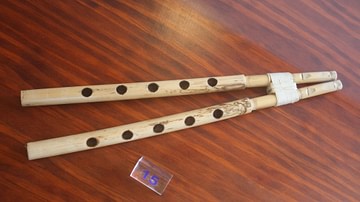
The aulos was a musical wind instrument played by the ancient Greeks. It was also known as the kalamos or libykos lotos, which referred to the material from which part of the instrument was made: respectively, the reed and the Libyan...

Definition
Aegean
The Aegean Sea lies between the coast of Greece and Asia Minor (modern-day Turkey). It contains over 2,000 islands which were settled by the ancient Greeks; the largest among them being Crete (Kriti) and the best known and most often...

Definition
Artemisia I of Caria
Artemisia I of Caria (l. 480 BCE) was the queen of the Anatolian region of Caria (south of ancient Lydia, in modern-day Turkey). She is most famous for her role in the naval Battle of Salamis in 480 BCE in which she fought...

Definition
Hindu Architecture
Hindu architecture evolved over the centuries from simple rock-cut cave shrines to massive and ornate temples which spread across the Indian sub-continent and beyond, forming a canonical style which is still adhered to today...

Definition
Carthaginian Art
The art of the Carthaginians was an eclectic mix of influences and styles, which included Egyptian motifs, Greek fashion, Phoenician gods, and Etruscan patterns. Precious metals, ivory, glass, terracotta, and stone were transformed...

Definition
Goryeo
Goryeo (Koryo) ruled Korea from 918 to 1392. The kingdom oversaw an unprecedented flourishing in culture and arts with developments in architecture, ceramics, printing, and papermaking. The kingdom was repeatedly invaded by the Mongols...

Definition
Constantine VII
Constantine VII was Byzantine emperor from 945 until 959 CE. Sometimes known as Constantine Porphyrogennetos because of his birth in the purple chamber of the royal palace, he was served by various regents from 912 CE until reigning...
