
Search
Remove Ads
Advertisement
Search Results

Definition
Marie Antoinette
Marie Antoinette (l. 1755-1793) was the queen of France during the turbulent final years of the Ancien Régime and the subsequent French Revolution (1789-1799). With the ascension of her husband Louis XVI of France (r. 1774-1792...
Definition
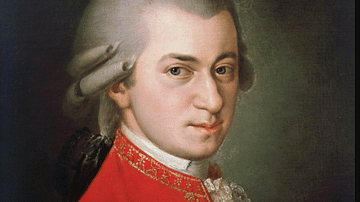
Wolfgang Amadeus Mozart
Wolfgang Amadeus Mozart (1756-1791) was an Austrian composer who wrote a wide range of works including piano concertos, string quartets, symphonies, operas, and sacred music. Regarded as one of or perhaps the greatest natural...

Article
The Siege of Acre, 1189-91 CE
The Siege of Acre, located on the northern coast of Israel, was the first major battle of the Third Crusade (1189-1192 CE). The protracted siege by a mixed force of European armies against the Muslim garrison and nearby...

Article
The Grand Embassy of Peter the Great
The Grand Embassy was the name given to the long Western European tour that Tsar Peter I of Russia (aka Peter the Great, r. 1682-1725) undertook during 1697-1698. Peter was joined by hundreds of people, including...

Article
Louis XVI, the Girondins, & the Road to Revolutionary War (1791-92)
On 20 April 1792, King Louis XVI of France (r. 1774-1792) stood before the Legislative Assembly and, with a faltering voice, read a declaration of war against Austria, to the ecstatic delight...

Definition
Louis XIV of France - The Sun King
Louis XIV (1638-1715) reigned as King of France from 1643 to 1715. Known as Le Roi Soleil ('the Sun King'), he fervently believed in the concept of the 'divine right' of kings and is remembered for ruling as an absolute...

Definition
King William's War - The First Great Colonial War Between England and France
King William’s War (1688-1697) was the first of four major colonial conflicts fought between England, France, and their respective Native American allies in the 17th and 18th centuries...

Definition
January Uprising of 1863 - Polish Rebellion Against Russian Rule in Poland
The January Uprising of 1863 was a conflict between Tsarist Russia and Polish insurgents striving for independence. The uprising continued until October 1864, when it was suppressed...

Article
Ivory & the Colonization of Africa
European colonising powers sought to exploit Africa's resources from the 15th century onwards. Arab traders had been doing the same in North Africa and East Africa through the Middle Ages, but it was from the 17th...

Image
Map of the Scramble for Africa after the Berlin Conference
The Berlin Conference (1884–1885), also known as the Congo Conference, marked a defining moment in the Scramble for Africa—the competitive colonization of the continent by European powers during...
