
Search
Search Results

Definition
Roman Warfare
Roman warfare was remarkably successful over many centuries and across many territories. This was due to several important factors. Italy was a peninsula not easily attacked, there was a huge pool of fighting men to draw upon, a disciplined...

Definition
Publius Quinctilius Varus
Publius Quinctilius Varus (c. 46 BCE – 9 CE) was a Roman politician and general under the rule of Emperor Augustus. He is most remembered for having lost three Roman legions when ambushed by Germanic tribes in the battle of Teutoburg Forest...

Definition
Julius Caesar
Gaius Julius Caesar was born 12 July 100 BCE (though some cite 102 as his birth year). His father, also Gaius Julius Caesar, was a Praetor who governed the province of Asia and his mother, Aurelia Cotta, was of noble birth. Both held to the...
Definition
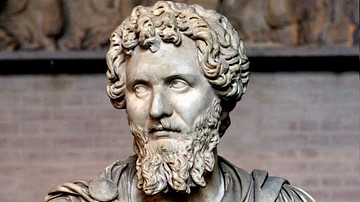
Septimius Severus
Lucius Septimius Severus was Roman emperor from April 193 to February 211 CE. He was of Libyan descent from Lepcis Magna and came from a locally prominent Punic family who had a history of rising to senatorial as well as consular status...
Definition
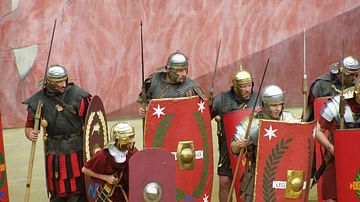
Legio I Adiutrix
Legio I Adiutrix was a legion of the Roman army formed from veteran sailors after the death of Roman emperor Nero (r. 54-68 CE). During its long career, the legion accompanied Trajan (r. 98-117 CE) on his Dacian and Parthian campaigns, fought...

Article
Battle of Teutoburg Forest
At the Battle of Teutoburg Forest (aka Battle of Varus), c. 9 CE, a combined force of Germans annihilated a Roman army consisting of three legions including three squadrons of cavalry and six cohorts of auxiliary troops. As some soldiers...

Article
Herod the Great's Building Program
Herod the Great was the king of Judea from 37-4 BCE. As a client king of Rome, Herod's moniker as "Great" was due more to his grand building program throughout the eastern Mediterranean world. Herod's building program generally ran from 35...
Article
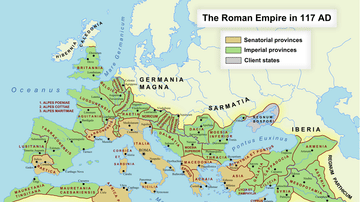
The Extent of the Roman Empire
Time has seen the rise and fall of a number of great empires - the Babylonian, the Assyrian, the Egyptian, and lastly, the Persian. Regardless of the size or skill of their army or the capabilities of their leaders, all of these empires fell...

Article
Nativity of Jesus
The nativity of Jesus of Nazareth is told in the gospels of Matthew and Luke. In Christian theology, the existence of two nativity stories by two different writers provided a prooftext for the historicity of the event. However, the two versions...

Article
Caesarea Maritima's Role in the Roman Empire
Caesarea Maritima, the city Herod the Great (r. 37-4 BCE) built for Rome on the southeastern coast of the Mediterranean served as the Roman Empire's powerbase of operations both commercially and militarily. With Rome's ultimate goal of adding...
