
Search
Search Results

Definition
Marcus Licinius Crassus - The Richest Ever Roman
Marcus Licinius Crassus (115-53 BCE) was perhaps the richest man in Roman history and in his eventful life he experienced both great successes and severe disappointments. His vast wealth and sharp political skills brought him two consulships...
Definition
Cato the Younger
Marcus Porcius Cato (95-46 BCE), better known as Cato the Younger or Cato of Utica, was an influential politician of the Roman Republic. As the great-grandson of Cato the Elder and a dedicated student of Stoicism, he believed in traditional...

Definition
Social War
The Social War (also called the Marsi War or the War of the Allies) of 91-87 BCE was the result of decades of contention between Rome and its Italian allies. Roman warfare relied heavily on the Italian allies (socii), but the Roman Republic...

Definition
Hadrian's Wall
Hadrian's Wall (known in antiquity as the Vallum Hadriani or the Vallum Aelian) is a defensive frontier work in northern Britain which dates from 122 CE. The wall ran from coast to coast at a length of 73 statute miles (120 km). Though the...
Definition
Decius
Decius was Roman emperor from 249 to 251 CE. In 249 CE Roman emperor Philip the Arab sent senator Decius to be the governor of the troubled provinces of Moesia and Pannonia. Roman legions under the ineffective command of the governor there...
Definition
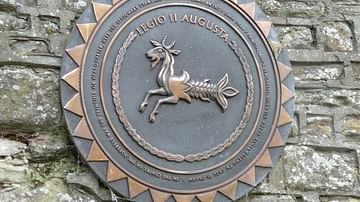
Legio II Augusta
Legio II Augusta was a legion of the Roman army that, throughout its centuries-long history, had fought in the Cantabrian Wars of 29-19 BCE, Germanicus' German campaigns in 9 CE, the invasion of Britain in 43 CE, and Septimus Severus' Scottish...
Image
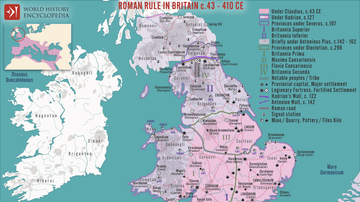
Map of the Roman Rule in Britain c. 43 - 410 CE - Four Centuries of Empire at the Edge of the World
Roman rule in Britain developed between 43 and 410 CE, reshaping the island from a mosaic of tribal societies into a province integrated into the political, economic, and cultural structures of the Roman Empire. Although Julius Caesar’s expeditions...

Article
Twelve Gods of Persian Mythology
Ancient Persian Mythology is the term now referencing ancient Iranian religion prior to the rise of Zoroastrianism between c. 1500-1000 BCE. This was a polytheistic faith with a pantheon led by the supreme god Ahura Mazda (“Lord of Wisdom”...

Article
Constantine’s Conversion to Christianity
Constantine I (Flavius Valerius Constantinus) was Roman emperor from 306-337 CE and is known to history as Constantine the Great for his conversion to Christianity in 312 CE and his subsequent Christianization of the Roman Empire. His conversion...
Article
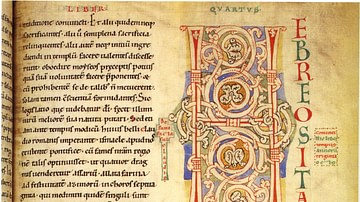
Josephus on Christianity
Titus Flavius Josephus (36-100 CE), the Jewish historian, is the main source for understanding Second Temple Judaism in the 1st century CE. In the last decades of the 1st century CE, he wrote The Jewish War, the Antiquities of the Jews, Against...
