
Search
Did you mean: Harsha?
Remove Ads
Advertisement

 This answer was generated by
 Search Results
Image
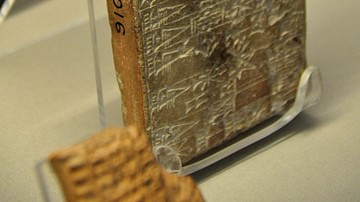
Foundation Clay Tablet from Larsa
This clay tablet records the restoration of the temple of the sun god Shamash at Larsa (modern-day Sankarah or Tell as-Senkereh) by King Hammurabi. Old Babylonian Period, reign of Hammurabi, 1792-1750 BCE. From Larsa...

Image
Cylinder of Warad-Sin of Larsa
An inscribed clay cylinder of Warad-Sin, ruler of Larsa. From Babylon (modern Babel Governorate, Iraq). 1834-1823 BCE. (The Pergamon Museum, Berlin).

Definition
Hammurabi - Conquerer, King, and Law-Giver
Hammurabi (reign 1792-1750 BCE) was the sixth king of the Amorite First Dynasty of Babylon, best known for his famous law code, which served as the model for others, including the Mosaic Law of the Bible. He...

Definition
Sumerian King List - Who Was King? And Who Was Not King?
The Sumerian King List (abbreviated as SKL and also known as Chronicle of the One Monarchy) is an ancient Sumerian document whose earliest version is dated to Mesopotamia's Ur III period (circa...

Definition
Babylon - The Gate of the Gods
Babylon is the most famous city from ancient Mesopotamia, whose ruins lie in modern-day Hillah, Iraq, 59 miles (94 km) southwest of Baghdad. The name is derived from bav-il or bav-ilim, which in Akkadian meant "Gate...

Definition
Code of Hammurabi - The Most Influential Law Code of the Ancient World
The Code of Hammurabi was a set of 282 laws inscribed in stone by the Babylonian king Hammurabi (reign 1792-1750 BCE), who conquered and then ruled ancient Mesopotamia. Although his law...

Definition
Code of Ur-Nammu - The Oldest Law Code in the World
The Code of Ur-Nammu (circa 2100-2050 BCE) is the oldest extant law code in the world. It was written by the Sumerian king Ur-Nammu (reign circa 2112-2094 BCE) or his son Shulgi of Ur (reign 2094 to...

Definition
Mesopotamian Warfare - Early Development of Armed Conflict
Ancient Mesopotamian warfare progressed from companies of a city's militia in Sumer to the professional standing armies of Akkad, Babylon, Assyria, and Persia, and from conflicts over land or water...

Definition
Sumer - The Cradle of Civilization
Sumer was the southernmost region of ancient Mesopotamia (modern-day southern Iraq and parts of Kuwait), which has long been considered the cradle of civilization. The name comes from Akkadian, the language of the...
Image
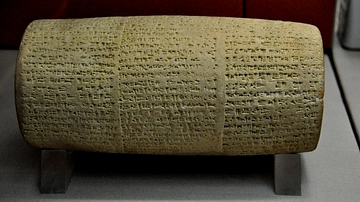
Terracotta Cylinder of King Nabonidus
This cylinder includes three columns of cuneiform inscriptions that record the reconstruction and restoration of the temple of Shamash, the sun God, at Larsa, by the last king of Babylon, Nabonidus. Probably from...
