
Search
Did you mean: Harsha?
Remove Ads
Advertisement
Search Results
Image
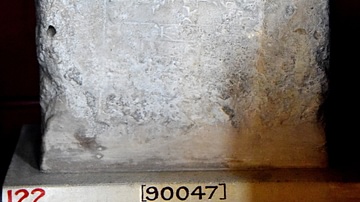
Mud Brick Stamped with the Name of Warad-Sin
This baked-mud brick was stamped with the name of king Warad-Sin, king of Larsa; reigned 1770-1758 BCE (short chronology) and possible co-regency with his father Kudur-Mabuk. The cuneiform inscriptions mention...

Article
Trade in Ancient Mesopotamia - How Commerce Encouraged Civilization
Local trade in ancient Mesopotamia began in the Ubaid period (circa 6500-4000 BCE), had developed into long-distance trade by the Uruk period (circa 4000-3100 BCE), and was flourishing by...
Article
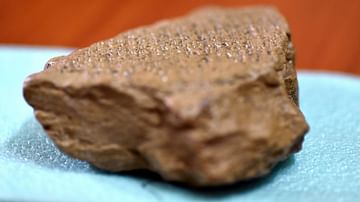
The Newly Discovered Tablet II of the Epic of Gilgamesh
Surpassing all other kings, heroic in stature, brave scion of Uruk, wild bull on the rampage! Going at the fore he was the vanguard, going at the rear, one his comrades could trust...
Image
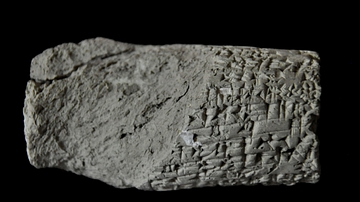
Tablet of King Nur-Adad
This partially broken document mentions the name of King Nur-Adad, king of Larsa, 1921-1905 BCE. (The Sulaimaniya Museum, Iraq).

Definition
Sumerians - Inventors of Civilization
The Sumerians were the people of southern Mesopotamia (modern-day southern Iraq) whose civilization flourished between circa 4000 and 1750 BCE. Their name comes from the region, which is frequently – and incorrectly...

Definition
Ur - The Great Biblical City Abandoned by the Gods
Ur was a city in the region of Sumer, in southern Mesopotamia, and its ruins lie in what is modern-day Tell el-Muqayyar, Iraq. According to biblical tradition, the city is named after the man who founded...

Definition
Utu-Shamash - Sumerian God of the Sun and Justice
Utu-Shamash (also known as Babbar, Samas, Shamash, and Utu) is the Sumerian god of the sun and divine justice. He is the son of the moon god Nanna and the fertility goddess Ningal in the Sumerian tradition...

Definition
Nanshe - The Selfless Sumerian Goddess of Social Justice
Nanshe (also known as Nanse, Nazi) is the Sumerian goddess of social justice and divination, whose popularity eventually transcended her original boundaries of southern Mesopotamia toward all points...

Definition
Early Dynastic Period in Mesopotamia - Era of Many of the "Firsts" in Civilization
The Early Dynastic period in Mesopotamia is the modern-day archaeological term for the era in Mesopotamian history – circa 2900 to circa 2350/2334 BCE – during which some of...
Image
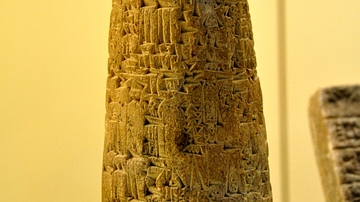
Cone of Sin-Iddinam
A foundation cone with cuneiform inscriptions. The name of the king Sin-Iddinam of Larsa appears. Isin-Larsa period, 1849-1843 BCE. From southern Mesopotamia, Iraq. The Pergamon Museum, Berlin).
