
Search
Did you mean: Kadesh?
Remove Ads
Advertisement
Search Results
Image
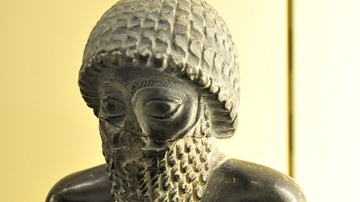
Statue of Ur-ningirsu
The cuneiform inscriptions on the back of this small diorite statue (height 18 cm) read, "Dedicated to the god Ningizzida, his god, by Ur-ningirsu, priest-prince of Lagash, son of Gudea, priest-prince of Lagash." This...

Image
An Inscribed Head of a Lioness
This piece was found at the throne of Akurgal, King of Lagash. First dynasty of Lagash, early dynastic period, circa 2500 BCE. From Girsu (modern Tell Telloh), Sumer, southern Mesopotamia, Iraq. (Istanbul Archaeological...
Image
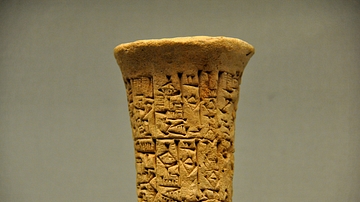
Foundation Peg of Entemena
This is a baked clay foundation peg, which was dedicated by Entemena, king of Lagash. It refers to a treaty with the king of Uruk. The political bond between Lagash and Uruk mentioned in this text is the earliest formal...

Article
The Battle of Kadesh & the First Peace Treaty
Ramesses II (The Great, 1279-1213 BCE) ruled Egypt for 67 years and, today, the Egyptian landscape still bears testimony to the prosperity of his reign in the many temples and monuments he had built in...

Article
Dogs & Their Collars in Ancient Mesopotamia - Man's Best Friend in the Ancient Near East
Among the many contributions to world culture credited to Mesopotamia is an object so familiar to people in the modern world that few pause to consider its origin: the dog...

Article
Hymn to Nisaba - A Praise Song for the Sumerian Goddess of Writing
The Hymn to Nisaba (circa 3rd millennium BCE) is a poem praising Nisaba, the Sumerian goddess of writing and accounts who also served as scribe of the gods. The poem is officially dedicated...
Image
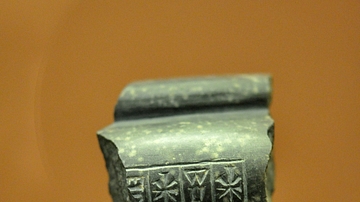
Votive Mace of Gudea
This votive stone mace head was polished and incised with four lines of cuneiform inscriptions. It was a dedication to the god Igalim by Gudea, ruler of Lagash. Lagash II period, c. 2150 BCE. From Lagash, Southern Mesopotamia...

Image
Goddess Nisaba
A fragment of a vase with a depiction of the goddess Nisaba (also Ninibgal or Nidaba), goddess of writing, learning, and the harvest. The cuneiform inscription on the vase mentions the name of Entemena, ruler of Lagash. Chlorite...
Image
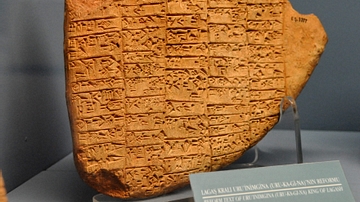
Terracotta Tablet from Girsu
This reform text belongs to King Uru'inimgina (or URU-KA-GI-NA), king of Lagash. From Girsu (modern Tell Telloh, Dhi-Qar Governorate, Iraq), Southern Mesopotamia, Iraq. Early dynastic period, 2351-2342 BCE. (Istanbul...

Image
King Enmetena's Foundation Stone
Pivot stone with inscription of the king Enmetena of Lagash. Circa 2340 BCE. (The Pergamon Museum, Berlin).
