
Search
Did you mean: Kadesh?
Remove Ads
Advertisement
Search Results

Definition
Ninurta - The Sumerian Hero-God of War
Ninurta (identified with Ningirsu, Pabilsag, and the biblical Nimrod) is the Sumerian and Akkadian hero-god of war, hunting, and the south wind. He first appears in texts in the early 3rd millennium BCE as an...

Definition
Nergal - The Mesopotamian God of Death, War, and Destruction
Nergal (also known as Erra and Irra) is the Mesopotamian god of death, war, and destruction. He began as a regional, probably agricultural, god of the Babylonian city of Kutha in the Sumerian...

Definition
Mari
Mari was a city-state located near the west bank of the Euphrates River in Northern Mesopotamia (now eastern Syria) during the Early Bronze Age and the Middle Bronze Age. One of the earliest known planned cities, Mari is believed to have...

Definition
Nisaba - Sumerian Goddess of Writing and Scribe of the Gods
Nisaba (also Naga, Se-Naga, Nissaba, Nidaba, and associated with Nanibgal) is the Sumerian goddess of writing, accounts, and scribe of the gods. Although her name is commonly given as Nidaba...

Definition
Gula - The Sumerian Goddess of Doctors and the Healing Arts
Gula (also known as Ninkarrak) is the Sumerian goddess of healing and patroness of doctors, healing arts, and medical practices. She is first attested to in the Ur III period (circa 2112 to circa...

Definition
Sumerian Language
The Sumerian language was spoken in southern Mesopotamia before the 2nd millennium BCE and was the first language to be written in the cuneiform script. It is an isolate language meaning we know of no other languages that relate...
Definition
Nehushtan
According to the Bible, Nehushtan was a metal serpent mounted on a staff that Moses had made, by God's command, to cure the Israelites of snake bites while wandering in the desert. The symbol of snakes on a staff or pole is a motif...

Image
Foundation Pegs, from Ningirsu Temple, Girsu
Each peg has a very faint cuneiform inscription of Gudea, the ruler of the city-state of Lagash. Foundation pegs were buried in the foundation of buildings to magically protect them and preserve the builder's...
Image
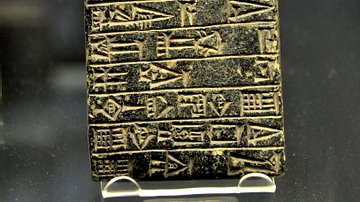
Stone Foundation Tablet of Gudea
This tablet mentions the name of Gudea, ruler of Lagash, to commemorate restoration of the Temple of Nindara. Found below the pavement of the Temple of Nindara at Ur, Southern Mesopotamia, modern-day Iraq. Lagash...

Image
Inscribed Giant River-worn Pebble
The cuneiform inscriptions mention that Enannatum, king of Lagash, reminds the gods of his prolific temple building achievements in the city of Lagash. From Girsu (modern-day Tell Telloh, Dhi-Qar Governorate, Iraq...
