
Search
Did you mean: Kadesh?
Remove Ads
Advertisement
Search Results
Image
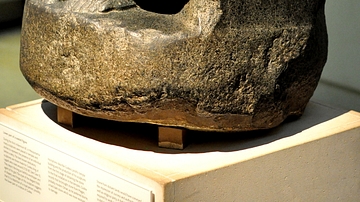
Seated Figure of Gudea
The lower half of this carved and polished granite statue has survived. It probably represents a seated figure of Gudea, ruler of Lagash. Lagash II period, circa 2150 BCE. From Seleucia ad Tigrim (5 miles south-west of Seleucia...

Image
Babylon at the time of Hammurabi
A locator map of Hammurabi's Babylonia, showing the Babylonian territory upon his ascension in 1792 BC and upon his death in 1750 BC. The river courses and coastline are those of that time period — in general, they...

Article
Trade in Ancient Mesopotamia - How Commerce Encouraged Civilization
Local trade in ancient Mesopotamia began in the Ubaid period (circa 6500-4000 BCE), had developed into long-distance trade by the Uruk period (circa 4000-3100 BCE), and was flourishing by...

Article
The Mesopotamian Pantheon - The Ancient Gods and Goddesses of the Near East
The gods of the Mesopotamian region were not uniform in name, power, provenance or status in the hierarchy. Mesopotamian culture varied from region to region and, because of this...

Article
The Legend of Sargon of Akkad - Inspiration for the Story of Moses
The Legend of Sargon of Akkad (circa 2300 BCE) is an Akkadian work from Mesopotamia understood as the autobiography of Sargon of Akkad (Sargon the Great, reign 2334-2279 BCE), founder of...

Article
A Brief History of Veterinary Medicine
The English word 'veterinarian' as defining one who provides medical care to animals, comes from the Latin verb veheri meaning “to draw” (as in "pull") and was first applied to those who cared for “any animal...
Article
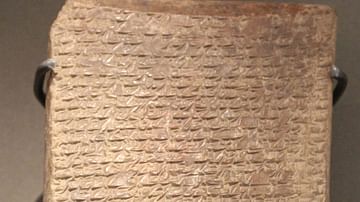
Ludlul-Bel-Nemeqi
The Ludlul-Bel-Nemeqi (c. 1700 BCE) is a Sumerian and later Babylonian poem on the theme of unjust suffering, which is thought to have influenced the biblical Book of Job. Also known as The Poem of the Righteous Sufferer, the...

Article
The Iraq Museum: A Brightness in the Darkness
For whom have I labored? For whom have I journeyed? For whom have I suffered? I have gained absolutely nothing for myself, I have only profited the snake, the ground lion! The Epic of Gilgamesh, Tablet...

Image
Map of the Sumerian Civilization - Where Cities Began
The rise of Sumerian civilization in southern Mesopotamia (c. 6000–2300 BCE) represents one of the earliest transformations from agrarian village life to urban state formation. Located between the...
Image
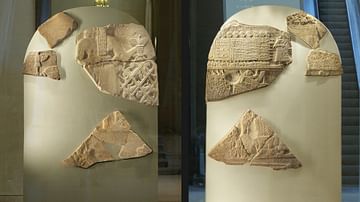
Stele of the Vultures
Stele of the Vultures fragments, dated to the Early Dynastic III Period (2600-2334 BCE), commemorating the victory of the city of Lagash over Umma.
Louvre, Paris.
