
Search
Did you mean: Kadesh?
Remove Ads
Advertisement
Search Results

Image
Battle Scene from Stele of the Vultures c. 2600 BCE
The Battle Scene from the Stele of the Vultures, created to commemorate the victory of Lagash over Umma c. 2600 BCE.
Louvre, Paris.
Image
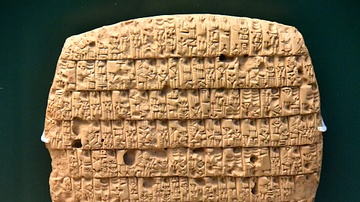
Distribution of Barley Rations Tablet from Girsu
Adult workers received standard rations of 30 to 40 pints of barley per month while children received 20; the barley was distributed as rations to about 200 workmen and their children. This scribe was...
Image
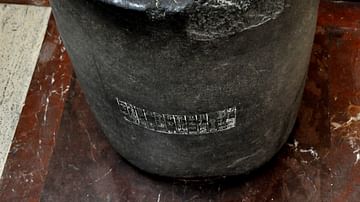
Diorite Mortar
This mortar was an offering from Gudea (ruler of Lagash) to the god Enlil. Neo-Sumerian era, 2141-2122 BCE. From Nippur (modern Nuffar, Al-Qadisiyah Governorate, Iraq), southern Mesopotamia.(Istanbul Archaeological Museums/Ancient...
Image
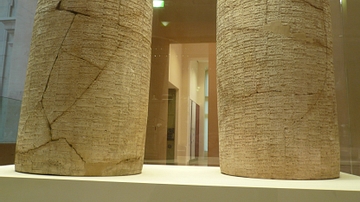
Gudea Cylinders
These two cylinders were commissioned by Gudea of Lagash (c. 2144-2124 BCE) as a literary and historical record of the construction of the temple of Ningirsu.
Louvre, Paris
Image
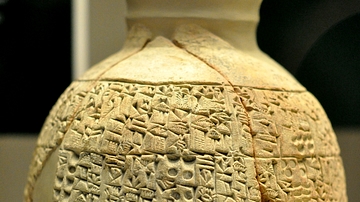
Vessel from Umma
"This is the boundary according to the monument of (the god) Shara". This is the historical cuneiform text on this vessel, which gives the city of Umma's account of its long-running border dispute with Lagash. Early Dynastic III...
Image
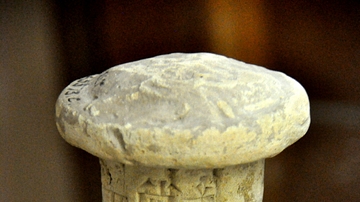
Foundation Cone of Gudea
This foundation cone records the building of a temple at Girsu by Gudea, ruler of Lagash. From Girsu (modern Tell Telloh, Dhi-Qar Governorate, Iraq), Southern Mesopotamia, Iraq. Reign of Gudea, 2144-2124 BCE. (The Sulaimaniya...

Image
Seal Lock
Terracotta seal lock from Lagash, southern Mesopotamia, modern-day Iraq. Neo-Sumerian period (Ur III), 2114-2004 BCE. (Istanbul Archeological Museums/Ancient Orient Museum, Istanbul, Turkey).

Image
A Foundation Peg from the Temple of Nanshe
This copper alloy foundation deposit records the rebuilding of the temple of the god Nanshe in the city of Sirara (modern Zerghul, southern Iraq) by Gudea, ruler of Lagash. It features a bull in a reed marsh...
Image
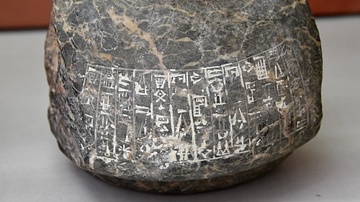
Votive Mace Head of Ur-Ningirsu II from Girsu
This grey stone mace head was inscribed with a cuneiform text. The text says that this mace head was dedicated to the god Ningirsu by Ur-Ningirsu II (son of Gudea, ruler of Lagash). From Girsu, Sothern...
Image
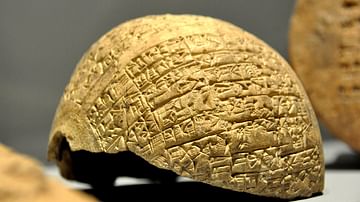
Inscribed Stand Head of Entemena
The cuneiform inscription on this stand's head mentions the name of Entemena, ruler of Lagash. Early Dynastic Period, c. 2400 BCE. From Southern Mesopotamia, modern-day Iraq. (The Sulaimaniya Museum, Iraq).
