
Search
Remove Ads
Advertisement
Search Results

Video
The Kingdom of the Mitanni ~ A Bronze Age Empire
The Kingdom of Mittani, known to the people of the land, and the Assyrians, as Hanigalbat and to the Egyptians as Naharin and Metani, once stretched from present-day northern Iraq, down through Syria and into Turkey and was considered a great...

Video
King Ergamenes and the Meroitic Empire (Ancient Nubia) (Kingdom of Kush)
King Ergamenes (also known as King Arkamani I, r. 295-275 BCE) was the greatest king of the city of Meroe, Kingdom of Kush (located in modern-day Sudan) who broke free from Egyptian dominance to help direct a wholly distinct culture. The...

Video
Clovis I: The Germanic Tribal Leader Who Created The Kingdom Of France
Clovis I was a Germanic tribal leader who is considered the founder of the medieval kingdom of France. He rose from a relatively minor ruler in northern Gaul to become the most powerful leader in what is now the modern nation of France...

Video
Korean History - Goguryeo Kingdom
Goguryeo was a powerful kingdom which ruled Northeast Korea during the Three Kingdoms period and was established in 37 BCE.

Video
Lords of the Mountains: The Foundation of the Armenian Kingdom of Cilicia
For nearly three centuries between 1080 and 1375 a kingdom of exiles from the Armenian Plateau survived in the Taurus Mountains of modern day south-central Turkey. This is the story of the foundation of Armenian Cilicia during the maelstrom...

Definition
Ancient Egyptian Architecture
Ancient Egyptian architecture is often associated closely with the pyramids of Giza but was actually quite diverse, taking a number of forms in the construction of administrative buildings, temples, tombs, palaces, and the private homes of...

Video
Gusuku Sites and Related Properties of the Kingdom of ... (UNESCO/NHK)
Five hundred years of Ryukyuan history (12th-17th century A.D.) are represented by this group of sites and monuments. The ruins of the castles, on imposing elevated sites, are evidence for the social structure over much of that period, while...
Definition
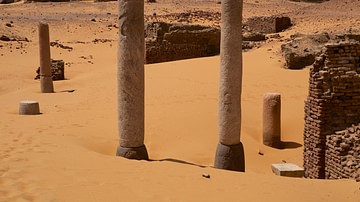
Old Dongola
Old Dongola (aka Dungulah or Dunkula), located in modern Sudan, was the capital of the ancient Nubian kingdom of Dongola (aka Makuria or Makurra) which flourished from the 6th to 14th century CE. A Christian kingdom for at least 750 years...

Article
Fashion & Dress in Ancient Egypt
Fashion in ancient Egypt epitomized the concept of simplicity and ease in movement and remained relatively unchanged in this regard for over 3,000 years. Clothing and footwear differed in ornamentation between the upper and lower classes...

Article
A Brief History of Egyptian Art
Art is an essential aspect of any civilization. Once the basic human needs have been taken care of such as food, shelter, some form of community law, and a religious belief, cultures begin producing artwork, and often all of these developments...
