
Search
Did you mean: Quran?
Remove Ads
Advertisement
Search Results

Image
Prisoners from the Town of -alammu
The Assyrian army of Sennacherib captured the city of -alammu. This gypsum wall relief depicts Assyrian soldiers carrying the beheaded heads of their defeated enemy. Prisoners are being reviewed by Sennacherib (who...

Image
Chlorite Bowl from Ur
Vessels of soft stone, including chlorite or steatite, came from Iran and they demonstrate the extensive trade network of the cities of Southern Mesopotamia during this period. This green chlorite vessel is straight-sided...

Image
Khotan Figure of a Bearded Man
The oasis state of Khotan with its capital at Yotkan, south of the Taklamakan desert, was a prosperous and powerful kingdom. Excavations have yielded many terracotta figures and ceramics of a Hellenistic style adopted...

Video
Mesopotamia and the Fertile Crescent - A Short History
Mesopotamia is an ancient region in the Middle East, east of the Mediterranean by the Zagros mountains, between the two rivers Tigris and Euphrates. The name ‘Mesopotamia’ comes from the Greek meaning...

Image
Colossal Bull Head, Persepolis
Colossal Bull Head from Hundred-Column Hall, Dark gray limestone, Persepolis (Iran), Achaemenid Period (Reign of Xerxes and Ataxerxes I, 486-424 BCE), Oriental Institute, University of Chicago.
Image
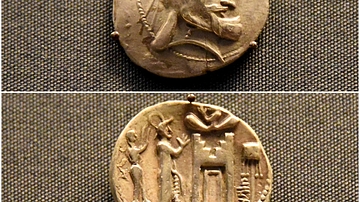
Silver Coin of Vadfradad I
This coin depicts Vadfradad I, king of Persis (Fars) in Southern Iran, who can be identified on both sides of the coin by his special headgear. On the back (lower image), a figure holds up a royal headband (diadem) as...

Image
The City of -alammu
This relief is part of a larger sequence showing the Assyrian military campaign and attack on the city of -alammu. The city gate, wall, and towers are shown here; the towers are occupied by soldiers trying to defend their city...
Image
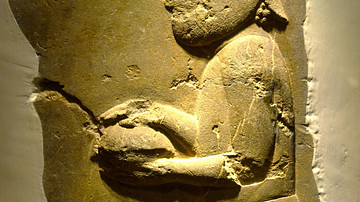
Relief of a Median Man
This relief from Persepolis, Iran shows a Median man climbing a staircase. Experts are quite sure what he's holding in his hands, but it might a stone or a shield. This relief is made from gray limestone and dates from the...
Image
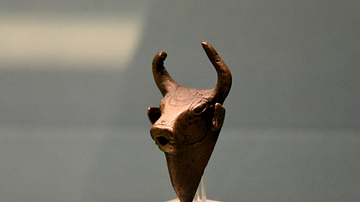
Urartian Bull's Head Spout
This bronze spout was shaped like a bull's head. The horns are curved and there is an ornamented forelock. From Urmia, north-western Iran. Urartian, 8th to 7th century BCE. (The British Museum, London).
Image
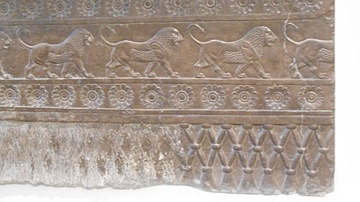
Striding Lions, Persepolis
Frieze of Striding Lions, Perspolis (Iran), Palace G, Limestone, Achaemenid Period (Reign of Darius I and Xerxes, 522-465 BCE), Oriental Institute, University of Chicago This carving represents a cloth canopy with tassels...
