
Search
Did you mean: Quran?
Remove Ads
Advertisement
Search Results
Image
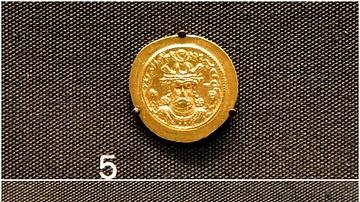
Coins of Kosrau I
These coins show the Sassanian "King of Kings" Kosrau I (aka Khosrow I), reigned 531-579 CE. He wears and holds a royal headband (diadem) as a symbol of kingship. Elements of earlier coins, such as the star and moon, are also...

Image
Gift-Bearer from Persepolis
This limestone wall relief shows a man holding a gift for the king. The man wears the typical Persian garment. From Persepolis, the Palace Terrace of Darius I (521-486 BCE) or Xerxes I (485-465 BCE), modern-day Iran...
Image
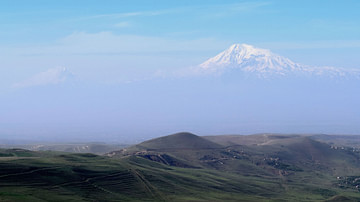
View of Mount Ararat from Armenia
Together, the Ararat Mountains straddle the borders of what are present-day Turkey, Armenia, Iran, and Azerbaijan. Mt. Ararat (“Greater Ararat”) rises to a height of 5,137 m (16,854 ft). Mt. Ararat’s neighboring...

Image
Medieval Jewish Tombstone in Yeghegis, Armenia
Nearly 40 tombstones from the 13th and 14th century CE survive in the Jewish cemetery, and another 30 are located nearby. The oldest tombstone dates to 1266 CE and the latest to 1337 CE. Some tombs have...

Video
Ancient Persia and the Achaemenid Persian Empire
The region of ancient Persia, which is modern-day Iran, has one of the longest histories, reaching back to the Palaeolithic Age, some one hundred thousand years ago. Between circa 1500 and 1000 BCE, a...

Image
Map of the Fertile Crescent and the Origins of Agriculture - Early Farming and Domestication in the Ancient Near East
The Fertile Crescent, a term coined in 1916 by Egyptologist James Henry Breasted, describes an arc of Southwest Asia stretching from the eastern Mediterranean...

Image
Map of the Mauryan Empire, c. 321 - 185 BCE
A map illustrating the rise and expansion of the Mauryan empire, the first pan-Indian empire that covered most of India and parts of present-day Iran. Chandragupta Maurya, the first ruler, seized the opportunity...
Image
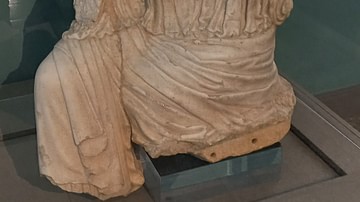
Statue of Penelope from Persepolis
Statue of Penelope, marble copy of the bronze original, found in Persepolis in 1936, dated to c. 450 BCE. National Museum of Iran, Tehran, acc. no. 1538 This marble torso of a seated woman in sophisticated drapes...

Image
12 Ancient Scripts We Still Cannot Read - Undeciphered Scripts & Lost Languages of the Ancient World
Throughout history, writing and other recording systems allowed societies to preserve information about administration, trade, religion, and political life. Many...

Image
Kudurru from Sippar
This kudduru (boundary stone) is a document which records the services of Ritti-Marduk, commander of the chariots, in a royal military campaign against Elam in southern Iran. As a reward, his ancestral territory was made exempt...
