
Search
Did you mean: Quran?
Remove Ads
Advertisement
Search Results

Image
Nasta 'liq Calligraphy
Nasta 'liq calligraphy by Isma'il Jalayir, Iran, c. 1860 CE.
Metropolitan Museum of Art, New York.

Image
Saltman from Zanjan Mine
Saltman No. 2, from the Zanjan Mine in Iran, currently on display in
Zanjan Musem. (Image 4)

Video
Persepolis (UNESCO/NHK)
Founded by Darius I in 518 B.C., Persepolis in present-day Iran was the capital of the Achaemenid Empire. It was built on an immense half-artificial, half-natural terrace, where the king of kings created an impressive palace...

Image
Kirat Minaret, Isfahan
An illustration by F.AlSulaiti of the Kirat Minaret, Khurasan, Iran (11th century CE). Seljuk era patron unknown. Balcony at the middle of the shaft missing which was supported on corbelled brick and decorated with Muqarnas...
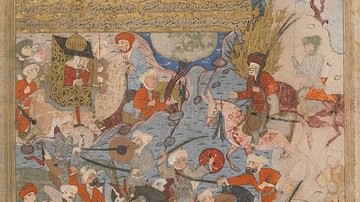
Image
Ali & Aisha at the Battle of the Camel
A painting from manuscript of the "Rawdat al-safa" (Persian for "Gardens of Purity") made in Iran c. 1571 - 1572 CE. The painting depicts Ali (r. 656 - 661 CE) and Aisha (c. 613 - 678 CE), who led the opposing...

Image
Ardashir I & Ahura Mazda
A drawing of a 3rd century CE Sasanian rock relief in Naqsh-e Rustam, Iran. The relief shows on the right Ardashir I (r. 224-241 CE) and on the left the supreme Persian and Zoroastrian god Ahura Mazda. The god is giving...

Image
Natanz Fire Temple
Sassanian Fire Temple, Natanz, Iran.

Image
The Fire Ordeal of Siyavush
The Fire Ordeal of Siyavush, Folio from a Shahnameh (Persian Book of Kings) of Ferdowsi (935–1020 CE)
Iran, 1482 CE

Image
Elamite Cup
Silver cup from Marvdasht, Fars, with linear-Elamite inscription on it. Late 3rd Millennium BC. National Museum of Iran.

Image
Equestrian Relief of Shapur I
Sasanian relief in Naqsh-e Rajab (Iran) depicting Sharpur I (r. 240-270 CE) on horseback (identified by a trilingual inscription) followed by a group of nine people. Naqsh-e Rajab is the site of four limestone rockface...
