
Search
Remove Ads
Advertisement
Search Results

Definition
Mithra
Mithra is the Persian god of the rising sun, contracts, covenants, and friendship. He also oversaw the orderly change of the seasons, maintained cosmic order, and was responsible for bestowing divine grace on kings, legitimizing their rule...

Definition
Ancient Persian Mythology
The mythology of ancient Persia originally developed in the region known as Greater Iran (the Caucasus, Central Asia, South Asia, and West Asia). The Persians were initially part of a migratory people who referred to themselves as Aryan...

Definition
Slavs
The term "Slavs" designates an ethnic group of people who share a long-term cultural continuity and who speak a set of related languages known as the Slavic languages (all of which belong to the Indo-European language family). Little is known...

Definition
Hurrians
The Hurrians (aka Hurri or Khurri) were a Bronze Age people who flourished across the Near East from the 4th millennium BCE to the 1st millennium BCE. Hurrian is also the name of the language these people spoke and, indeed, is the one constant...

Definition
Apsaras and Gandharvas
In the Vedas, the apsaras are water nymphs, often married to the gandharvas. By the time the Puranas and the two epics were composed, the apsaras and gandharvas had become performing artists to the gods; the apsaras are singers, dancers...

Definition
Etruscan Language
The language of the Etruscans, like the people themselves, has remained somewhat mysterious and has yet to be fully understood. The alphabet used a western Greek script, but the language has presented difficulties to scholars because it is...
Definition
Cilicia Campestris
Cilicia Campestris was one of the six districts of the Roman province of Cilicia organized by Pompey the Great (l. c. 106-48 BCE) in 64 BCE. The name translates roughly into “Cilicia of the Plains” and corresponds to the earlier name for...

Video
Timeline of World History | Major Time Periods & Ages
A timeline of world history, chronicling major events and historical eras.
Article
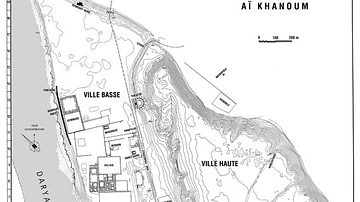
Ai Khanum, the Capital of Eucratides
Ai Khanum (also spelled Ai-Khanoum or Ay-Khanum, lit. “Lady Moon” in Uzbek), was founded in the 4th century BC, following the conquests of Alexander the Great and was one of the primary cities of the Greco-Bactrian kingdom. The site is located...

Article
Another Ariamanus Statue Found: The Evil Spirit of Mithraic Religion
It is rare when a new find creates renewed interest in an old subject. Here, the new find is a leontocephaline (lion-headed) figure of unknown provenance, weighing 5.8 kg and 37 cm in height with a width of 14 cm. Its base is partially broken...
