
Search
Remove Ads
Advertisement
Search Results

Definition
Hinduism
Hinduism is the oldest religion in the world, originating in Central Asia and the Indus Valley, still practiced in the present day. The term Hinduism is what is known as an exonym (a name given by others to a people, place, or concept) and...

Definition
Hellenistic Period
The Hellenistic Period is a part of the Ancient Period for the European and Near Asian space. The use of this period is justified by the extent of the Hellenic culture in most of these areas, due to the Greek political presence especially...

Definition
Sanskrit
Sanskrit is regarded as the ancient language in Hinduism, where it was used as a means of communication and dialogue by the Hindu Celestial Gods, and then by the Indo-Aryans. Sanskrit is also widely used in Jainism, Buddhism, and Sikhism...

Definition
Gandhara Civilization
The Gandhara Civilization existed in what is now Northern Pakistan and Afghanistan from the middle of the 1st millennium BCE to the beginning of the 2nd millennium CE. Although multiple major powers ruled over this area during that time...

Definition
Anahita
Anahita is the ancient Persian goddess of fertility, water, health and healing, and wisdom. Owing to her association with life-giving properties, she also came to be connected with ancient Persian warfare as soldiers would pray to her for...
Definition
Kharosthi Script
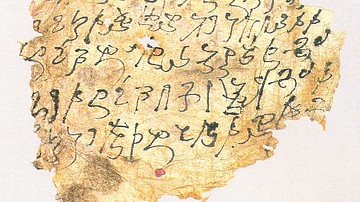
The Kharosthi script (also known as 'Indo-Bactrian' script) was a writing system originally developed in present-day northern Pakistan, sometime between the 4th and 3rd century BCE. Kharosthi was employed to represent a form of Prakrit (Middle...

Definition
Greco-Bactrian Kingdom
The Greco-Bactrian kingdom refers to several dynasties and probably kingdoms of Greco-Macedonian monarchs who ruled over Bactria from 250 to 130 BCE. Foundation The Greco-Bactrian kingdom appeared in 250 BCE, when the satrap Diodotos...

Definition
Kalash Culture
The Kalash people, also called Kafir (Non-believer), Black Robe and Siah Posh, live in the three sub-valleys of Kalash; Bumboret, Rumbor and Birir, in the modern-day District Chitral, Pakistan. The Kalasha are ancient tribe of Pakistan and...
Image
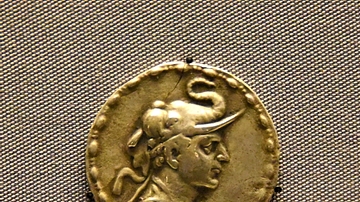
Coin of Lysias
Silver coin of the Indo-Greek King Lysias Anicetus, reigned 130-120 BCE. The King wears an elephant head. From modern-day North-West India/Pakistan. (The British Museum, London).
Image
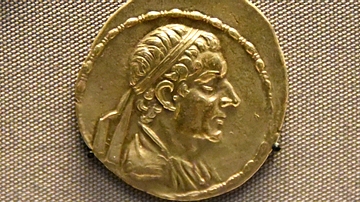
Coin of Theophilus
Silver coin the Indo-Greek King Theophilus (Theophilos) the Autocrat, reigned 130s or 90 BCE. From modern-day North-West India/Pakistan. (The British Museum, London).
