
Search
Remove Ads
Advertisement
Search Results
Definition
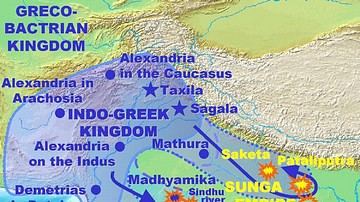
Indo-Greek
The first Indo-Greek kingdom appeared circa 190 BCE may when the Greco-Bactrian king or (general for his father) Demetrios was busy in India, when his Indian possessions were divided between several kings, probably firstly in order to better...

Definition
Indo-European Languages
The Indo-European languages are a family of related languages that today are widely spoken in the Americas, Europe, and also Western and Southern Asia. Just as languages such as Spanish, French, Portuguese and Italian are all descended from...
Article
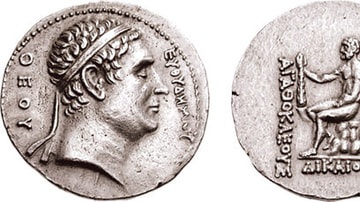
Some new hypotheses on the problems of the Indo-Greek kingdoms
Warning: See the definitions of Greco-Bactrian and Indo-Greek Kingdoms before reading this article, otherwise the following lines could give you serious headaches! A lack of information is a common problem for historians of the Greco-Bactrian...

Article
Greco-Bactrian and Indo-Greek Kingdoms in Ancient Texts
The rarity of the appearance of Greco-Bactrian and Indo-Greek kingdoms in ancient literature is one of the reasons why those states are so little-known today. Indo-Greek literature did exist, but none has been found that speaks about the...

Article
Cultural Links between India & the Greco-Roman World
Cyrus the Great (558-530 BCE) built the first universal empire, stretching from Greece to the Indus River. This was the famous Achaemenid Empire of Persia. An inscription at Naqsh-i-Rustam, the tomb of his able successor Darius I (521-486...
Article
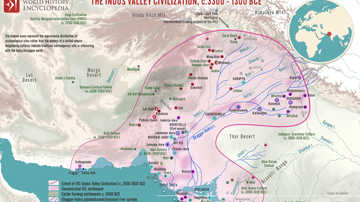
Religious Developments in Ancient India
For well over 1,000 years, sacred stories and heroic epics have made up the mythology of Hinduism. Nothing in these complex yet colourful legends is fixed and firm. Pulsing with creation, destruction, love, and war, it shifts and changes...

Definition
Aryan
Aryan is a designation originally meaning “civilized”, “noble”, or “free” without reference to any ethnicity. It was first applied as a self-identifying term by a migratory group of people from Central Asia later known as Indo-Iranians (who...
Definition
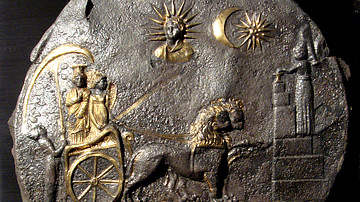
Ancient Afghanistan
The ancient history of Afghanistan, a landlocked country in Central Asia, is full of fascinating cultures, from early nomadic tribes to the realms of Achaemenid Persia, the Seleucids, the Mauryans, the Parthians, and Sasanians, as well as...

Image
Indo-European language family tree
Partial tree of Indo-European languages. Branches are in order of first attestation; those to the left are Centum, those to the right are Satem. Languages in red are extinct. White labels indicate categories / un-attested proto-languages...

Definition
Romani Language
Romani is an Indo-European language, belonging to the Indic subbranch which includes Sanskrit and Hindi. Because of the Romani diaspora throughout Europe and West Asia, it developed in close contact with European and Iranian languages. It...
