
Search
Remove Ads
Advertisement
Search Results
Image
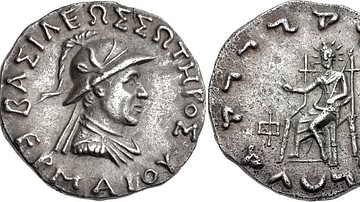
Hermaios Silver Tetradrachm
BAKTRIA, Indo-Greek Kingdom. Hermaios. Circa 105-90 BC. AR Tetradrachm (26mm, 9.61 g, 12h). Obverse:Diademed and draped bust right, wearing helmet adorned with bull's horn and ear Reverse: Zeus enthroned facing slightly left, holding...
Image
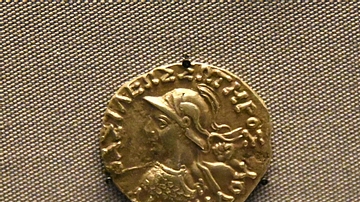
Coin of Diomedes
Silver coin the Indo-Greek King Diomedes Soter, reigned 95-90 BCE. From modern-day North-West India/Pakistan. (The British Museum, London).
Image
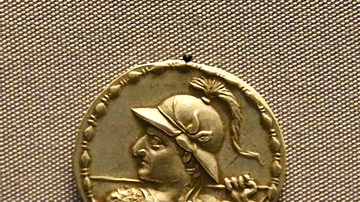
Coin of Archebius
Silver coin of the Indo-Greek King Archebius Dikaios Nikephoros, reigned 90-80 BCE. From modern-day North-West India/Pakistan. (The British Museum, London).

Article
Five Key Historical Sites of the Hittites
Although mentioned several times in the Biblical texts, the actual existence of the Hittites was largely forgotten until the late 19th century CE. With the discovery of Hattusa in 1834 CE, the city that was for many years the capital of the...
Image
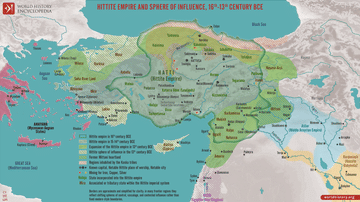
Map of the Hittite Empire 16th-13th Century BCE - Anatolian Great Power of the Bronze Age
The Hittite Empire emerged in central Anatolia during the early second millennium BCE and developed into one of the major powers of the Late Bronze Age. Centered on Hattusa, it ruled over a culturally diverse realm rooted in the older land...
Image
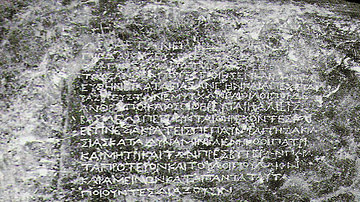
Greek and Aramaic inscriptions by king Ashoka
Bilingual (Greek and Aramaic) inscriptions by king Ashoka at Kandahar (Shar-i-kuna). (3rd century BCE). Preserved at Kabul Museum. Today disappeared. Two-dimensional inscription. Greek (transliteration) 1. δέκα ἐτῶν πληρηεὺς...

Image
Map of India in the Vedic Age, 1500 BCE-500 BCE - Indo-Aryan Cultures in Northern India
The Vedic Age (c. 1500-500 BCE) marks a formative period in the history of the northern Indian subcontinent, bridging the decline of the Indus Valley Civilization (c. 1300 BCE) and the emergence of early states in the Gangetic plain. During...

Definition
Medes
The Medes or Medians were a group of Indo-Iranian-speaking people from central Asia who migrated westwards and entered northern Iran around the end of the 2nd millennium BCE. They settled in the highlands of Zagros (Zagreus in Greek) and...

Definition
Indus Script
The Indus Script is the writing system developed by the Indus Valley Civilization and it is the earliest form of writing known in the Indian subcontinent. The origin of this script is poorly understood: this writing system remains undeciphered...

Definition
Brahmi Script
The Brahmi script is the earliest writing system developed in India after the Indus script. It is one of the most influential writing systems; all modern Indian scripts and several hundred scripts found in Southeast and East Asia are derived...
