
Search
Remove Ads
Advertisement
Search Results

Article
Cultural Links between India & the Greco-Roman World
Cyrus the Great (558-530 BCE) built the first universal empire, stretching from Greece to the Indus River. This was the famous Achaemenid Empire of Persia. An inscription at Naqsh-i-Rustam, the tomb...

Article
Trade in the Roman World
Regional, inter-regional and international trade was a common feature of the Roman world. A mix of state control and a free market approach ensured goods produced in one location could be exported far and wide. Cereals...

Article
The Portuguese Conquest of India
Throughout the 15th century, the Portuguese Crown yearned for a piece of the Far Eastern spice trade. For centuries this trade had been dominated by the Venetians who obtained pepper, cloves, nutmeg, ginger and cinnamon...

Article
Trade in Medieval Europe
Trade and commerce in the medieval world developed to such an extent that even relatively small communities had access to weekly markets and, perhaps a day's travel away, larger but less frequent fairs, where the full range...
Article
Elephants In Ancient Indian Warfare
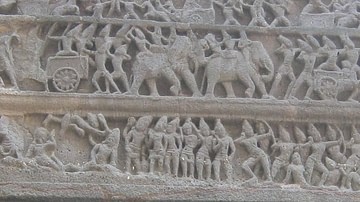
Elephants were used in the ancient Indian army, irrespective of regions, dynasties, or points in time; their importance was never denied and continued well into the medieval period as well. The ready availability...

Article
Chariots in Ancient Indian Warfare
The chariot was the elite arm of ancient Indian armies in the Vedic (1500 BCE – 1000 BCE) and Epic periods (described by the Ramayana and the Mahabharata, 1000-600 BCE) because of the advantages it conferred and...

Definition
French and Indian War - The Final Clash of Empires in North America
The French and Indian War (1754-1763) was the last great colonial conflict waged between Great Britain and France in North America. Often considered a theater of the global Seven Years'...

Article
Trade in Ancient Celtic Europe
Trade in raw materials and manufactured goods in ancient Celtic Europe was vibrant and far-reaching, particularly regarding the centre of the continent where there was a hub of well-established trade routes. As the...

Definition
Sepoy
A sepoy was an Indian soldier in the armies of various states and European trading companies in the Indian subcontinent and then, from the second half of the 19th century, in the British Indian Army. Recruited from many different population...

Article
Caesarea Maritima's Role in the Mediterranean Trade
Caesarea Maritima was located on the eastern coast of the Mediterranean Sea. Built from the ground up in 22-10 BCE by Rome's client king, Herod the Great (r. 37-4 BCE), its location in relation to ship...
